Mannanase in Laundry Detergent: Process Guide
B2B guide to mannanase in laundry detergent: dosing, stability tests, pilot validation, COA/TDS/SDS, and supplier qualification.

A practical buyer and formulator guide for specifying beta-mannanase in liquid and powder laundry detergents, with process ranges, validation steps, and sourcing checks.
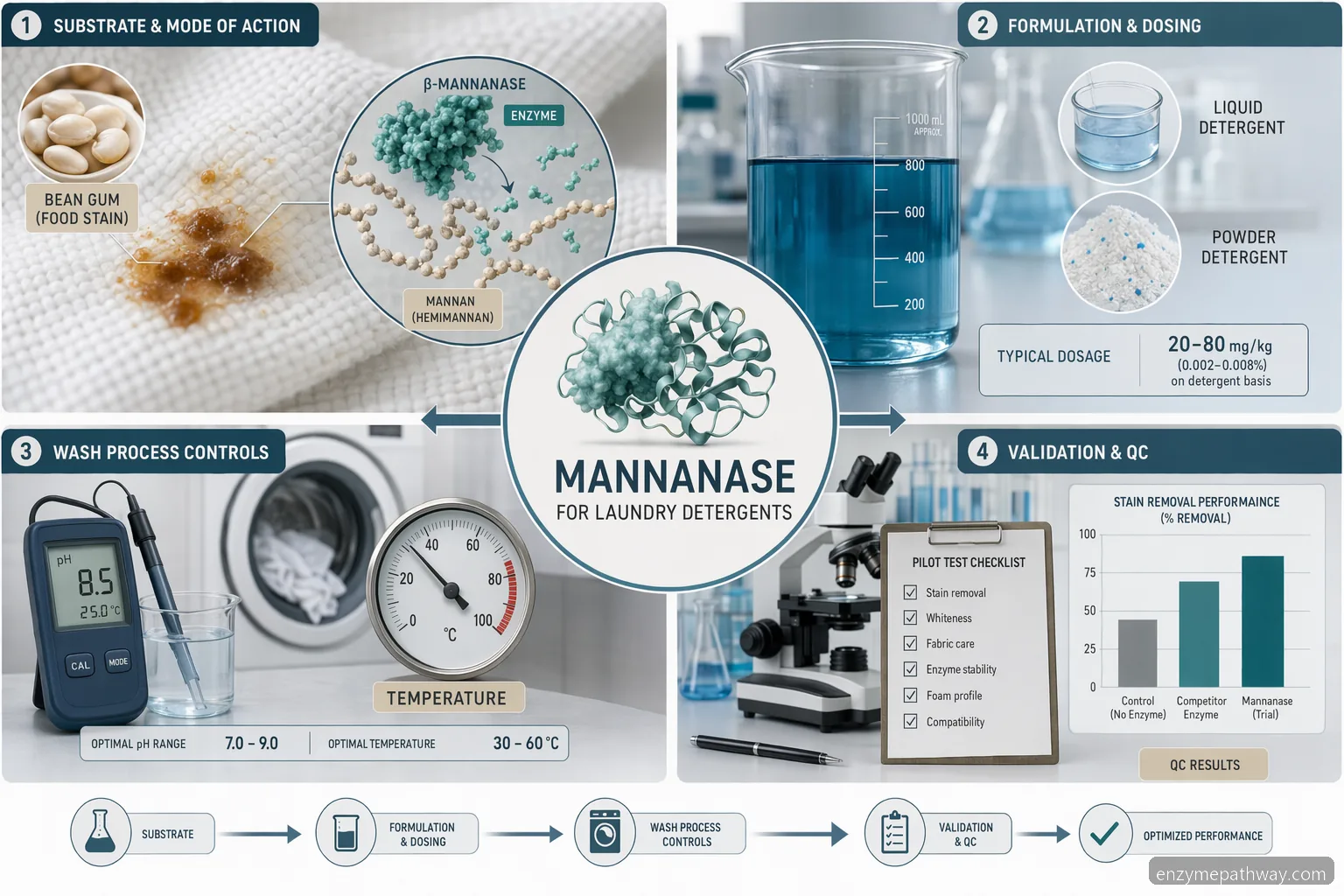
Why mannanase is used in detergent formulations
Mannanase in laundry detergent is selected for stains and soils that contain beta-mannan polysaccharides. These gums are common in food systems, personal care products, and industrial thickeners, including guar gum and locust bean gum. A mannanase enzyme hydrolyzes beta-1,4-mannan linkages, reducing the viscosity and adhesion of gum-containing residues so surfactants, builders, and mechanical action can remove them more efficiently. For B2B detergent producers, the value is not a generic enzyme claim; it is the measured improvement on defined stain panels at the target wash temperature, pH, water hardness, and detergent dose. Beta-mannanase is often evaluated alongside protease, amylase, lipase, cellulase, and pectate lyase, but its role is distinct. It is most useful where regional diets, food processing residues, or thickened consumer products create mannan-rich soils that remain visible after standard washing.
Primary substrate: beta-mannan gums and related galactomannans. • Common stain sources: sauces, ice cream, dressings, cosmetics, and gum-thickened foods. • Key decision metric: incremental stain removal versus total formulation cost.
Recommended formulation and wash-process ranges
The use of mannanase enzyme in detergent should be screened under the same conditions expected in-market. Many detergent-grade mannanase products are evaluated between pH 7.0 and 10.5, with optimal performance depending on strain, protein engineering, stabilizers, and formulation matrix. Practical wash testing often covers 20-60°C, because cold-water performance and warm-wash resilience are both commercially relevant. Initial dosage screening may start around 0.05-0.50% of the commercial enzyme preparation as supplied, or an equivalent activity-based range agreed with the supplier. Do not transfer dosage by weight alone between suppliers; activity units, purity, liquid carrier, granule coating, and stabilizer package can change cost-in-use. In liquid detergents, check compatibility with surfactants, chelants, solvents, preservatives, and water activity. In powders, evaluate granule integrity, dust level, segregation risk, and activity retention during storage.
Screen pH: 7.0-10.5, matched to the finished detergent. • Screen wash temperature: 20-60°C. • Trial dose: 0.05-0.50% as supplied, then optimize by activity and cost. • Confirm compatibility in the final surfactant and builder system.
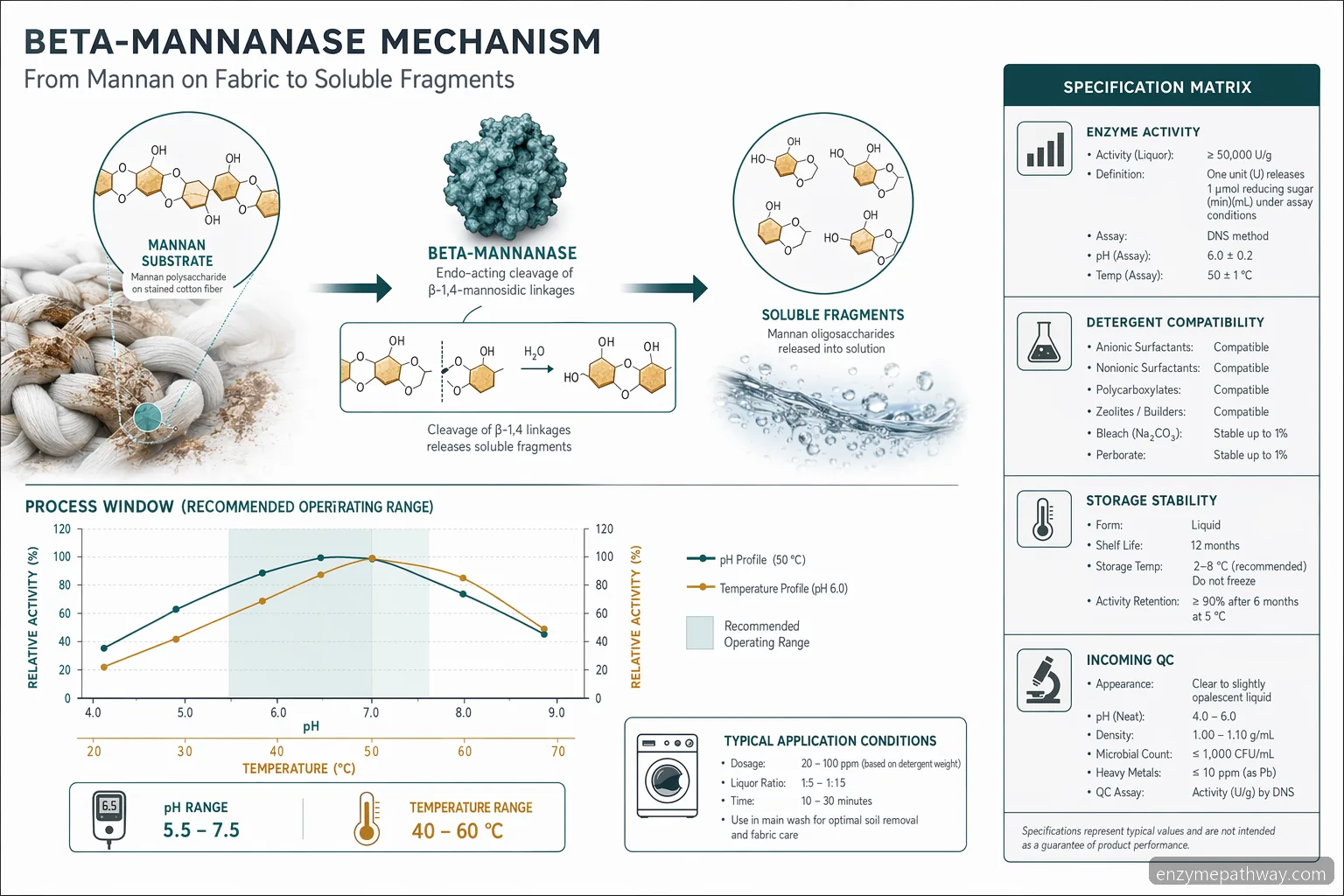
Pilot validation and performance testing
Performance of mannanase in laundry application should be validated through a controlled pilot protocol before commercialization. Use standardized mannan-containing stain swatches, internal consumer-relevant stains, and a detergent blank without enzyme. Measure reflectance or image-based stain removal after washing and drying, and include replicates for statistical confidence. A fluorescent stain imaging diagram in laundry detergent development can help visualize soil distribution, but the acceptance criterion should be quantitative, documented, and brand-neutral. Run tests at multiple water hardness levels, detergent dosages, and temperatures to identify where the enzyme is most valuable. Include a stress condition, such as elevated storage temperature or high alkalinity, to uncover formulation instability. Pilot validation should also record foam, odor, color, viscosity, phase stability, and packaging compatibility, especially for liquid detergent systems where enzyme stability can drive shelf-life risk.
Compare enzyme formula against a no-enzyme control. • Use triplicate swatches or statistically justified replicates. • Measure whiteness, stain removal index, or delta reflectance. • Test both fresh and aged detergent samples.
QC checks for incoming enzyme and finished detergent
A mannanase enzyme in detergent program needs routine QC beyond visual inspection. For incoming enzyme, review the Certificate of Analysis against purchase specifications, including activity, appearance, microbial limits if applicable, pH, moisture or solids, and batch number. The Technical Data Sheet should define activity units, recommended handling, formulation guidance, and storage conditions. The Safety Data Sheet should address respiratory sensitization risk, PPE, spill response, and safe industrial handling. For finished detergent, monitor residual mannanase activity after manufacture and during accelerated and real-time storage. Useful checkpoints include viscosity, pH, phase separation, odor, color, preservative compatibility, and enzyme activity after exposure to surfactants and chelants. For powder detergent, include granule size distribution, dust testing, enzyme segregation, and activity after compaction or transport simulation. QC limits should be tied to performance, not only supplier averages.
Request COA, TDS, SDS, batch traceability, and shelf-life statement. • Test residual activity after processing and storage. • Check liquid stability at ambient and elevated temperatures. • Audit dust control and allergen handling for enzyme powders.
Supplier qualification and cost-in-use purchasing
For industrial buyers, mannanase in detergent is a cost-in-use decision, not just a price-per-kilogram comparison. Qualify suppliers by reviewing technical responsiveness, batch consistency, lead time, documentation quality, regulatory support for target markets, and ability to supply pilot and scale quantities. Ask for activity-based pricing, recommended dosage bands, stability data in representative detergent matrices, and guidance on enzyme deactivation or cleaning if relevant to production. A lower-priced product may be less economical if it requires higher dosage, causes formulation instability, or loses activity during storage. Conversely, a concentrated or stabilized beta-mannanase may justify a higher unit price if it reduces rewash rates or enables lower wash temperatures. Supplier qualification should include sample testing, pilot validation, commercial-scale trial, agreed specifications, change notification terms, and a documented complaint process.
Compare cost per wash or cost per ton of finished detergent. • Require change notification for strain, carrier, activity, or site changes. • Confirm logistics, storage temperature, and shelf-life commitments. • Approve only after pilot and scale-up data match target performance.
Technical Buying Checklist
Buyer Questions
Mannanase hydrolyzes mannan and galactomannan gums that can bind stains to fabric. These soils may come from guar-thickened foods, sauces, desserts, cosmetics, and other gum-containing products. In a detergent system, the enzyme helps break the gum network so surfactants and mechanical washing can remove residues more effectively. Its value should be proven on relevant stain swatches under target wash conditions.
A practical first screen is often 0.05-0.50% of the commercial mannanase preparation as supplied, but the final level must be based on enzyme activity, formulation stability, wash dose, and cost-in-use. Do not compare suppliers only by weight addition. Request activity units, recommended dosage, and matrix compatibility data, then optimize through pilot washing trials and aged-sample performance checks.
Yes, mannanase can be used in liquid laundry detergent when the enzyme remains stable in the chosen surfactant, solvent, builder, preservative, and pH system. Liquid formulations require close monitoring of residual activity, viscosity, odor, color, and phase stability during real-time and accelerated storage. The supplier should provide TDS guidance and samples for testing in your actual detergent base.
Compare suppliers by performance per wash, not only price per kilogram. Review COA consistency, TDS clarity, SDS handling guidance, batch traceability, shelf life, lead time, technical support, and change notification practices. Run the same stain-removal protocol for each candidate at equivalent activity levels. Include storage stability and scale-up handling before approving a supplier for commercial detergent production.
Important QC tests include incoming enzyme activity, appearance, batch identity, pH or solids as relevant, and review of COA against specification. Finished detergent should be tested for residual enzyme activity, pH, viscosity, phase stability, odor, color, and stain-removal performance. For powder detergents, also check dust, granule integrity, segregation, moisture sensitivity, and activity after transport or storage simulation.
Related Search Themes
mannanase, new liquid tide w mannanase fluorescent diagram in laundry detergent, mannanase in detergent, mannanase enzyme laundry, mannanase enzyme in detergent, mannanase enzyme
Mannanase for Research & Industry
Need Mannanase for your lab or production process?
ISO 9001 certified · Food-grade & research-grade · Ships to 80+ countries
Frequently Asked Questions
What does mannanase do in laundry detergent?
Mannanase hydrolyzes mannan and galactomannan gums that can bind stains to fabric. These soils may come from guar-thickened foods, sauces, desserts, cosmetics, and other gum-containing products. In a detergent system, the enzyme helps break the gum network so surfactants and mechanical washing can remove residues more effectively. Its value should be proven on relevant stain swatches under target wash conditions.
What dosage of mannanase enzyme is typical in detergent?
A practical first screen is often 0.05-0.50% of the commercial mannanase preparation as supplied, but the final level must be based on enzyme activity, formulation stability, wash dose, and cost-in-use. Do not compare suppliers only by weight addition. Request activity units, recommended dosage, and matrix compatibility data, then optimize through pilot washing trials and aged-sample performance checks.
Is mannanase suitable for liquid laundry detergent?
Yes, mannanase can be used in liquid laundry detergent when the enzyme remains stable in the chosen surfactant, solvent, builder, preservative, and pH system. Liquid formulations require close monitoring of residual activity, viscosity, odor, color, and phase stability during real-time and accelerated storage. The supplier should provide TDS guidance and samples for testing in your actual detergent base.
How should we compare mannanase suppliers?
Compare suppliers by performance per wash, not only price per kilogram. Review COA consistency, TDS clarity, SDS handling guidance, batch traceability, shelf life, lead time, technical support, and change notification practices. Run the same stain-removal protocol for each candidate at equivalent activity levels. Include storage stability and scale-up handling before approving a supplier for commercial detergent production.
What QC tests are important for mannanase in detergent?
Important QC tests include incoming enzyme activity, appearance, batch identity, pH or solids as relevant, and review of COA against specification. Finished detergent should be tested for residual enzyme activity, pH, viscosity, phase stability, odor, color, and stain-removal performance. For powder detergents, also check dust, granule integrity, segregation, moisture sensitivity, and activity after transport or storage simulation.
Related: Mannanase for Mannan-Rich Process Streams
Turn This Guide Into a Supplier Brief Request detergent-grade mannanase samples, COA/TDS/SDS, and pilot support from Enzyme Pathway. See our application page for Mannanase for Mannan-Rich Process Streams at /applications/mannanase-industrial-processing/ for specs, MOQ, and a free 50 g sample.
Contact Us to Contribute