Perfomance of Mannanase in Laundry Application: Dosage, pH, Temperature, and Oil Drilling Transfer
Troubleshoot mannanase enzyme dosage, pH, temperature, and QC for laundry detergents and guar-based oil drilling fluids.
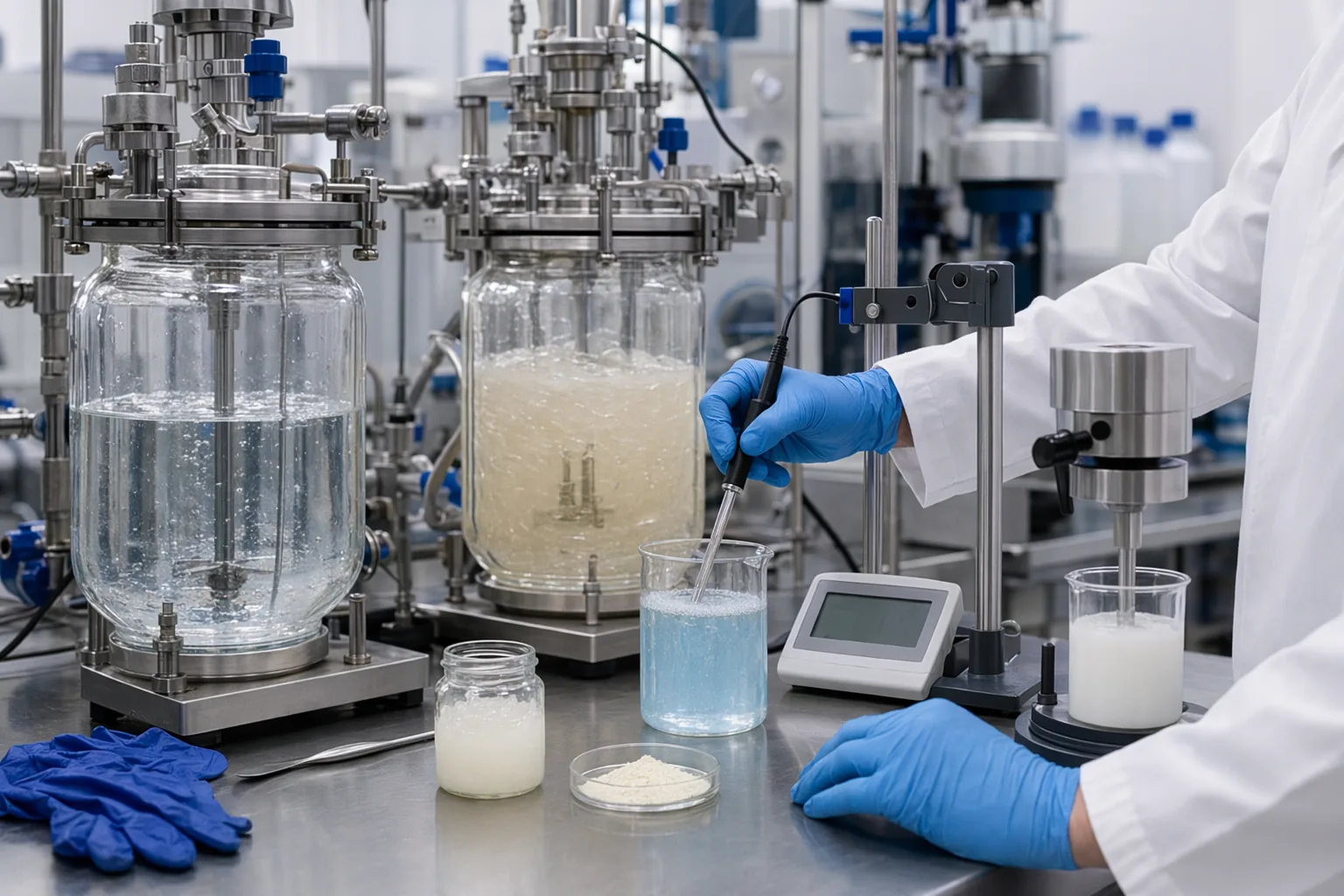
For B2B buyers, mannanase performance is a process-control question: match the enzyme grade to the substrate, chemistry, temperature, contact time, and measured cost-in-use before scale-up.
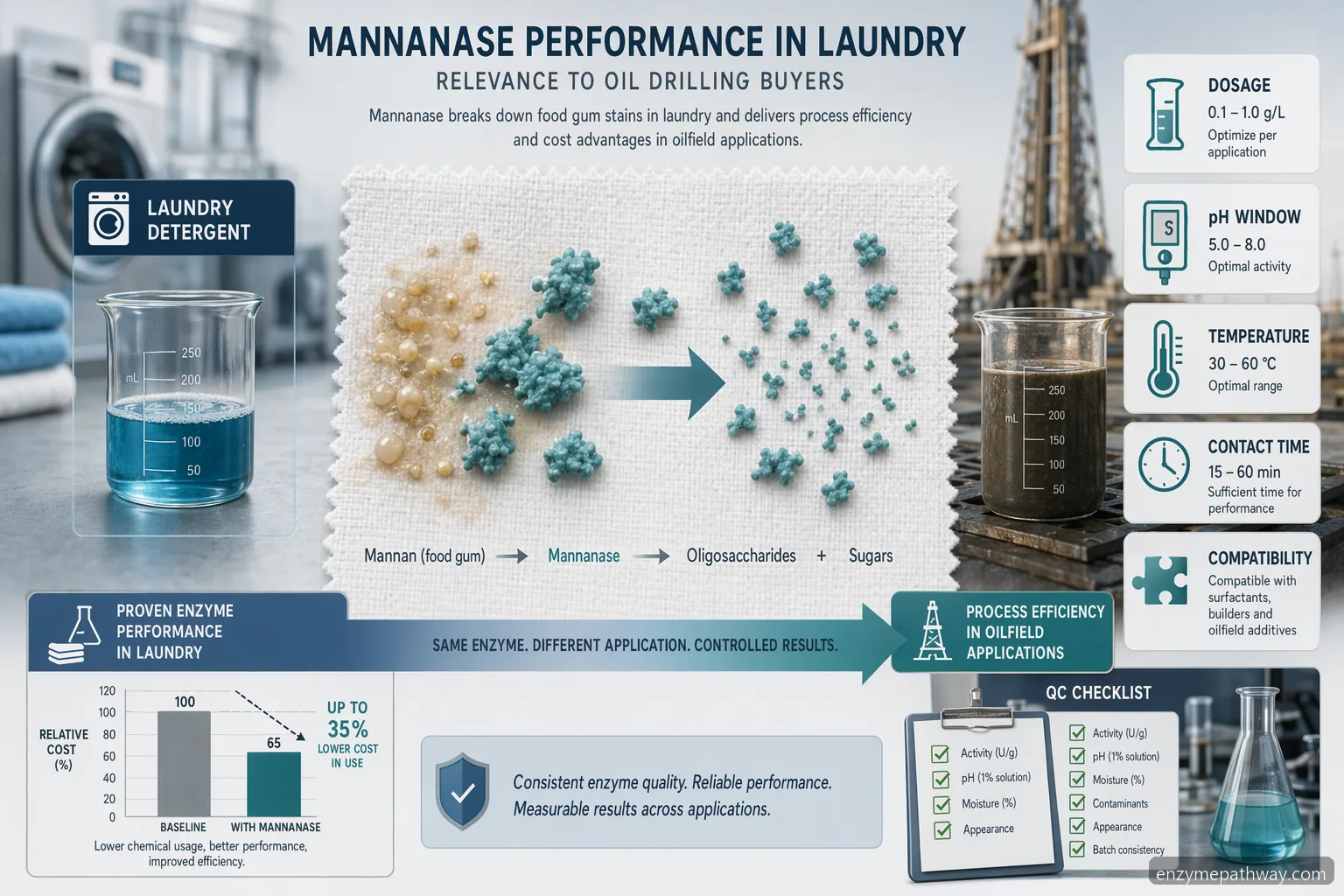
Why Laundry Mannanase Performance Matters to Drilling Buyers
The phrase perfomance of mannanase in laundry application is often searched by detergent teams, but the troubleshooting logic is useful for oil drilling buyers using guar-based fluids. Mannanase, including beta-mannanase, hydrolyzes beta-1,4-mannan backbones in guar gum and related galactomannans. In laundry detergent, the target is gum-rich food soil, body soil complexes, and redeposition films. In oil drilling or completion fluids, the target may be viscosity reduction, filter-cake weakening, or cleanup of guar residues after fluid service. The applications are not interchangeable: detergent grades emphasize alkaline stability and surfactant tolerance, while oilfield grades may require salinity tolerance, thermal stability, and compatibility with crosslinkers, breakers, biocides, and corrosion-control packages. Buyers should therefore use laundry data only as a starting point. The commercial decision should be based on process-specific trials, measurable endpoints, and cost-in-use under actual field chemistry.
Core substrate: guar gum and related beta-mannans • Laundry endpoint: stain and film removal • Oilfield endpoint: viscosity or residue reduction • Decision basis: pilot validation, not brochure activity alone
Dosage Troubleshooting and Cost-in-Use
Mannanase dosage should be optimized against the real substrate load, not copied from a different industry. For mannanase in laundry detergent, initial screening often evaluates about 5 to 100 ppm active enzyme in wash liquor, depending on activity definition, soil load, formulation, and contact time. For guar gum enzyme use in oil drilling fluids, early lab screening may start around 50 to 500 ppm enzyme product, or a supplier-recommended liquid dosage such as 0.1 to 2.0 L per cubic meter of treatment fluid. These are screening bands, not universal specifications. If dosage is too low, viscosity reduction or gum-soil removal may be incomplete. If dosage is too high, the incremental performance gain can flatten while cost rises. Calculate cost-in-use from delivered activity, storage loss, dilution, required contact time, and the value of reduced rewash, faster cleanup, lower breaker demand, or improved flowback.
Run blank, low, medium, and high dosage controls • Measure performance at expected contact time • Track enzyme cost per treated ton, cubic meter, or wash batch • Do not compare supplier prices without normalizing activity units
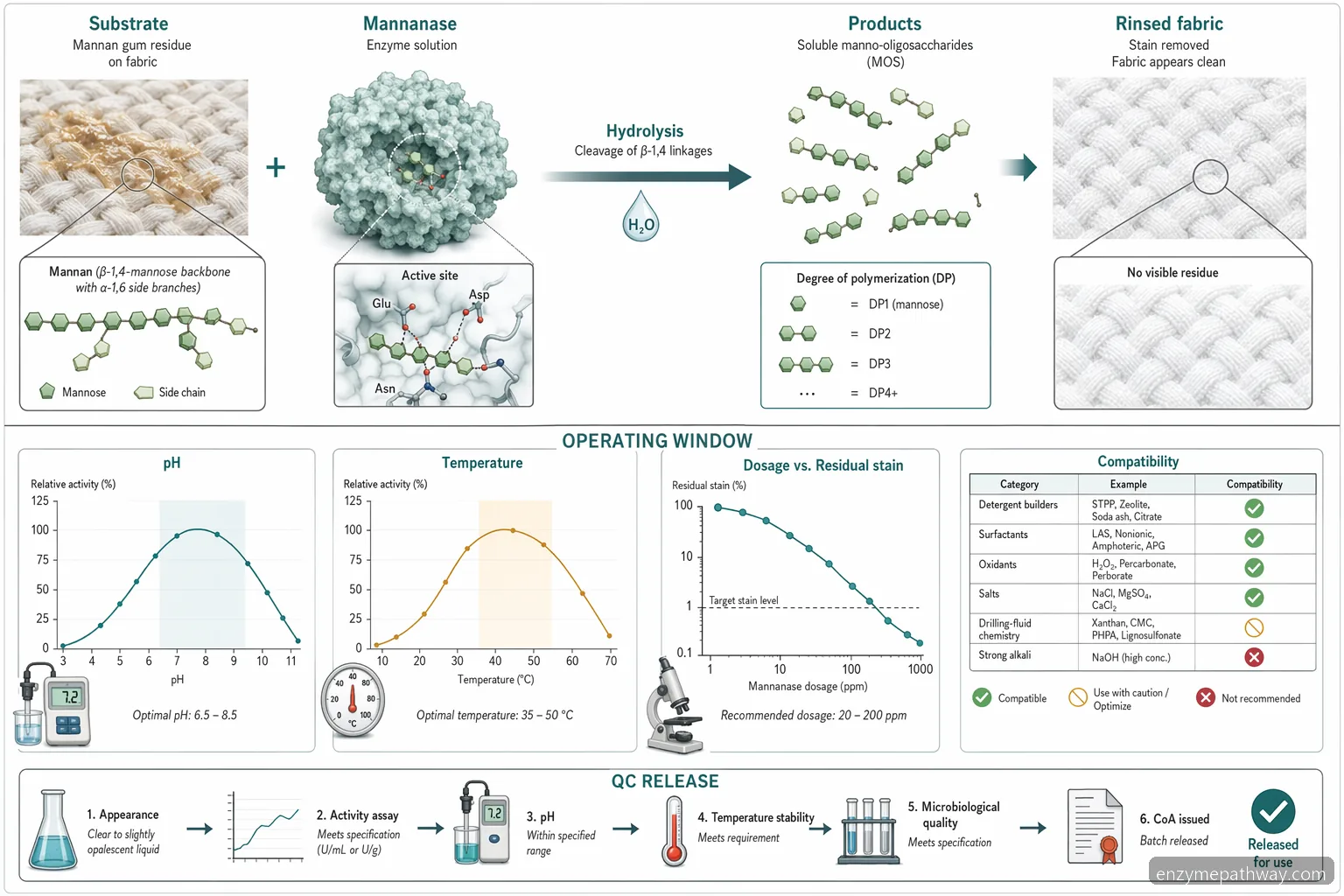
pH, Temperature, and Contact Time Windows
Mannanase enzyme function in laundry depends strongly on pH and temperature. Many detergent trials are run at pH 8.0 to 10.5 and 20 to 60 degrees Celsius, with short contact times from 10 to 45 minutes. Some beta-mannanase products tolerate higher alkalinity, but this must be confirmed in the finished detergent matrix. Oil drilling systems usually need a different validation window: pH 6.0 to 9.0 is common for many enzymatic guar cleanup trials, while temperature may range from ambient mixing conditions to 70 or 85 degrees Celsius in downhole or produced-fluid contact. Higher-temperature grades may be available, but activity half-life should be measured at the actual brine chemistry and pH. Contact time can range from minutes in a detergent wash to several hours in oilfield cleanup. If performance is inconsistent, first verify actual fluid pH, temperature history, and enzyme residence time before increasing dosage.
Laundry screening: pH 8.0-10.5, 20-60°C • Oilfield screening: pH 6.0-9.0, ambient-85°C • Confirm activity half-life under real chemistry • Optimize contact time before assuming enzyme failure
Compatibility Risks in Detergent and Oilfield Formulations
Poor mannanase laundry performance is often caused by incompatibility rather than weak enzyme quality. In detergents, evaluate anionic and nonionic surfactants, builders, chelants, preservatives, fragrance components, oxidants, and storage pH. Enzymes can lose activity during storage even if they perform well when freshly dosed. For oil drilling, compatibility checks should include brine salinity, calcium and magnesium hardness, borate or metal crosslinkers, pH adjusters, biocides, clay stabilizers, friction reducers, surfactants, and oxidizing breakers. Mannanase is a protein catalyst, so strong oxidants, extreme pH, and high heat can reduce useful activity. If an oxidizer is required for final cleanup, consider whether the enzyme should be applied earlier, later, or separately. Avoid relying on consumer detergent graphics or fluorescent diagrams as proof of industrial performance. Use controlled assays, substrate-relevant tests, and side-by-side supplier comparisons.
Check retained activity after formulation storage • Screen oxidants and biocides carefully • Use field brine, not only deionized water • Separate incompatible additives when practical
QC, Documentation, and Supplier Qualification
A qualified mannanase enzyme supplier should provide a current COA, TDS, and SDS for each commercial grade. The COA should identify batch number, activity method, activity value, appearance, and relevant microbiological or impurity limits where applicable to the intended industry. The TDS should define recommended pH, temperature, storage, dosage guidance, carrier system, and formulation cautions. The SDS should support safe handling, transport, and worker training. For supplier qualification, ask for activity retention data, shelf-life conditions, lot-to-lot consistency, sample availability, and change-control communication. Industrial buyers should run pilot validation before committing to bulk supply. For oil drilling, the pilot should include representative guar fluid, brine, additives, temperature profile, target viscosity or residue endpoint, and realistic mixing procedure. Approval should be based on performance, cost-in-use, documentation quality, supply reliability, and technical support responsiveness.
Require COA, TDS, and SDS before approval • Verify the activity assay and units • Run pilot validation with actual process chemistry • Qualify both product performance and supplier reliability
Technical Buying Checklist
Buyer Questions
In laundry, mannanase hydrolyzes beta-mannan gums from guar, locust bean gum, and similar food thickeners. These gums can bind particulate soil and create persistent films on fabric. The enzyme breaks the gum backbone into smaller, more removable fragments. Performance depends on detergent pH, wash temperature, surfactant package, oxidant exposure, soil load, and contact time.
Not without validation. A mannanase laundry grade may show useful activity on guar gum, but oil drilling fluids can contain high salinity, hardness ions, crosslinkers, biocides, pH adjusters, and elevated temperatures. These conditions can reduce enzyme activity or change the required dosage. Screen the enzyme in representative field fluid and compare it with an oilfield-oriented grade before purchasing bulk quantities.
Activity loss after storage can result from high pH, residual oxidants, incompatible preservatives, water activity, heat exposure, or interactions with surfactants and builders. In liquid detergent or liquid oilfield additives, run retained-activity tests at intended storage temperature and packaging conditions. Compare fresh enzyme dosing with aged formulation performance to separate enzyme quality issues from formulation stability problems.
Compare suppliers by delivered activity, activity assay method, lot consistency, formulation compatibility, retained activity, pilot performance, documentation, technical support, and supply reliability. Do not compare price per kilogram alone. Normalize by activity units and calculate cost-in-use at the dosage needed to reach the target wash result, viscosity reduction, residue cleanup, or filter-cake performance.
Useful QC checks include initial and final viscosity, retained enzyme activity, pH, salinity, temperature profile, filter-cake or residue mass, fluid appearance, and compatibility with crosslinkers or breakers. Include untreated blanks and chemical-breaker controls where relevant. The goal is to confirm that mannanase improves the targeted endpoint under realistic field chemistry before approving a commercial dosage.
Related Search Themes
mannanase, performance of mannanase in laundry application, mannanase in laundry detergent, mannanase enzyme laundry, mannanase enzyme, new liquid tide w mannanase fluorescent diagram in laundry detergent
Mannanase for Research & Industry
Need Mannanase for your lab or production process?
ISO 9001 certified · Food-grade & research-grade · Ships to 80+ countries
Frequently Asked Questions
What is the main mannanase enzyme function in laundry?
In laundry, mannanase hydrolyzes beta-mannan gums from guar, locust bean gum, and similar food thickeners. These gums can bind particulate soil and create persistent films on fabric. The enzyme breaks the gum backbone into smaller, more removable fragments. Performance depends on detergent pH, wash temperature, surfactant package, oxidant exposure, soil load, and contact time.
Can a mannanase laundry grade be used directly in oil drilling?
Not without validation. A mannanase laundry grade may show useful activity on guar gum, but oil drilling fluids can contain high salinity, hardness ions, crosslinkers, biocides, pH adjusters, and elevated temperatures. These conditions can reduce enzyme activity or change the required dosage. Screen the enzyme in representative field fluid and compare it with an oilfield-oriented grade before purchasing bulk quantities.
Why does mannanase performance drop after formulation storage?
Activity loss after storage can result from high pH, residual oxidants, incompatible preservatives, water activity, heat exposure, or interactions with surfactants and builders. In liquid detergent or liquid oilfield additives, run retained-activity tests at intended storage temperature and packaging conditions. Compare fresh enzyme dosing with aged formulation performance to separate enzyme quality issues from formulation stability problems.
How should buyers compare two mannanase suppliers?
Compare suppliers by delivered activity, activity assay method, lot consistency, formulation compatibility, retained activity, pilot performance, documentation, technical support, and supply reliability. Do not compare price per kilogram alone. Normalize by activity units and calculate cost-in-use at the dosage needed to reach the target wash result, viscosity reduction, residue cleanup, or filter-cake performance.
What QC tests are useful for oil drilling guar cleanup trials?
Useful QC checks include initial and final viscosity, retained enzyme activity, pH, salinity, temperature profile, filter-cake or residue mass, fluid appearance, and compatibility with crosslinkers or breakers. Include untreated blanks and chemical-breaker controls where relevant. The goal is to confirm that mannanase improves the targeted endpoint under realistic field chemistry before approving a commercial dosage.
Related: Mannanase for Mannan-Rich Process Streams
Turn This Guide Into a Supplier Brief Request a mannanase sample, COA/TDS/SDS package, and pilot validation support for your detergent or guar-based oilfield process. See our application page for Mannanase for Mannan-Rich Process Streams at /applications/mannanase-industrial-processing/ for specs, MOQ, and a free 50 g sample.
Contact Us to Contribute