Mannanase Production: Supplier Guide for Industrial Buyers
Compare mannanase enzyme suppliers for production: specs, pH/temperature fit, dosage trials, COA/TDS/SDS, pilot validation, and cost-in-use.
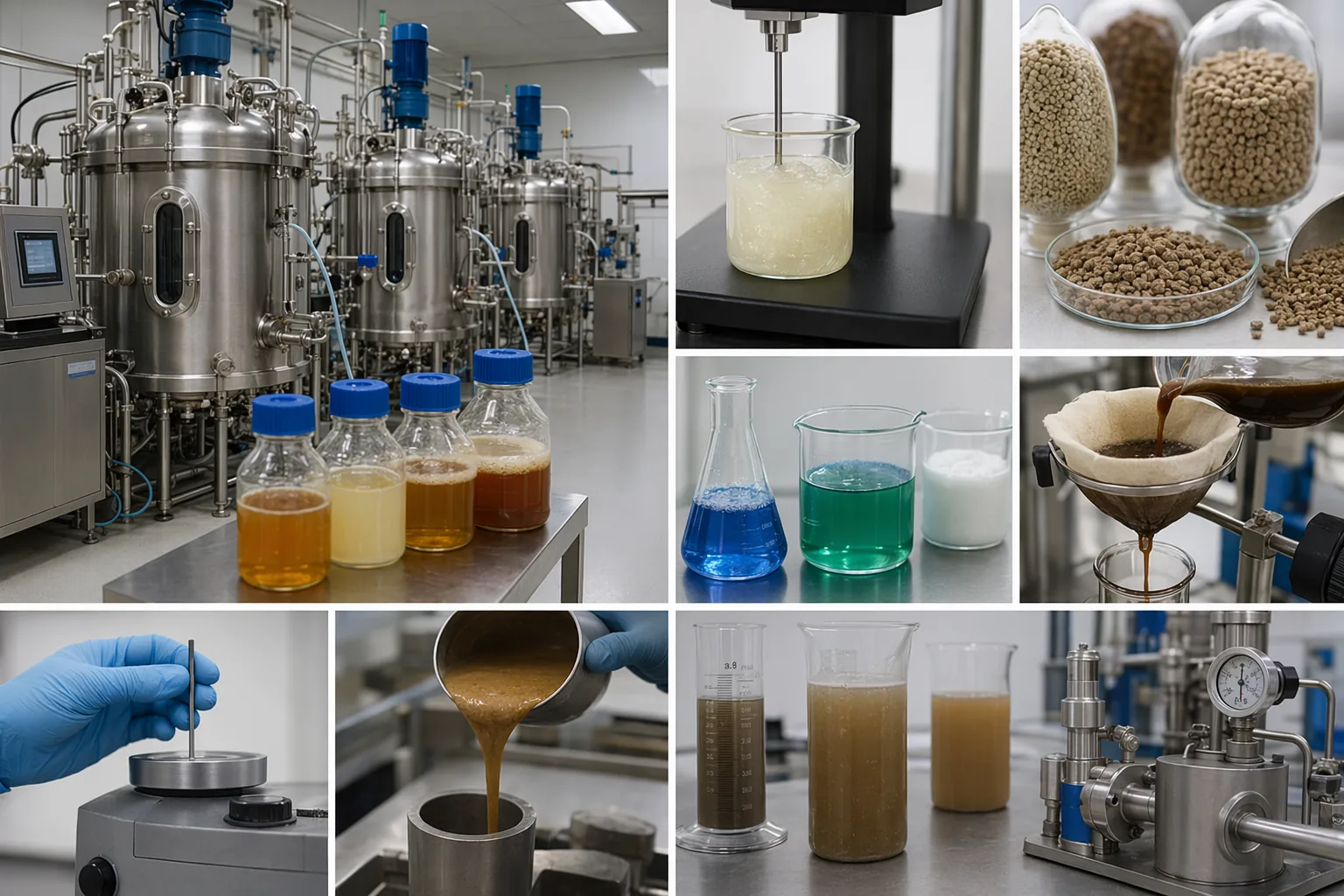
Select a mannanase enzyme for reliable production performance, documented quality, and measurable cost-in-use across feed, detergent, oilfield, and processing applications.
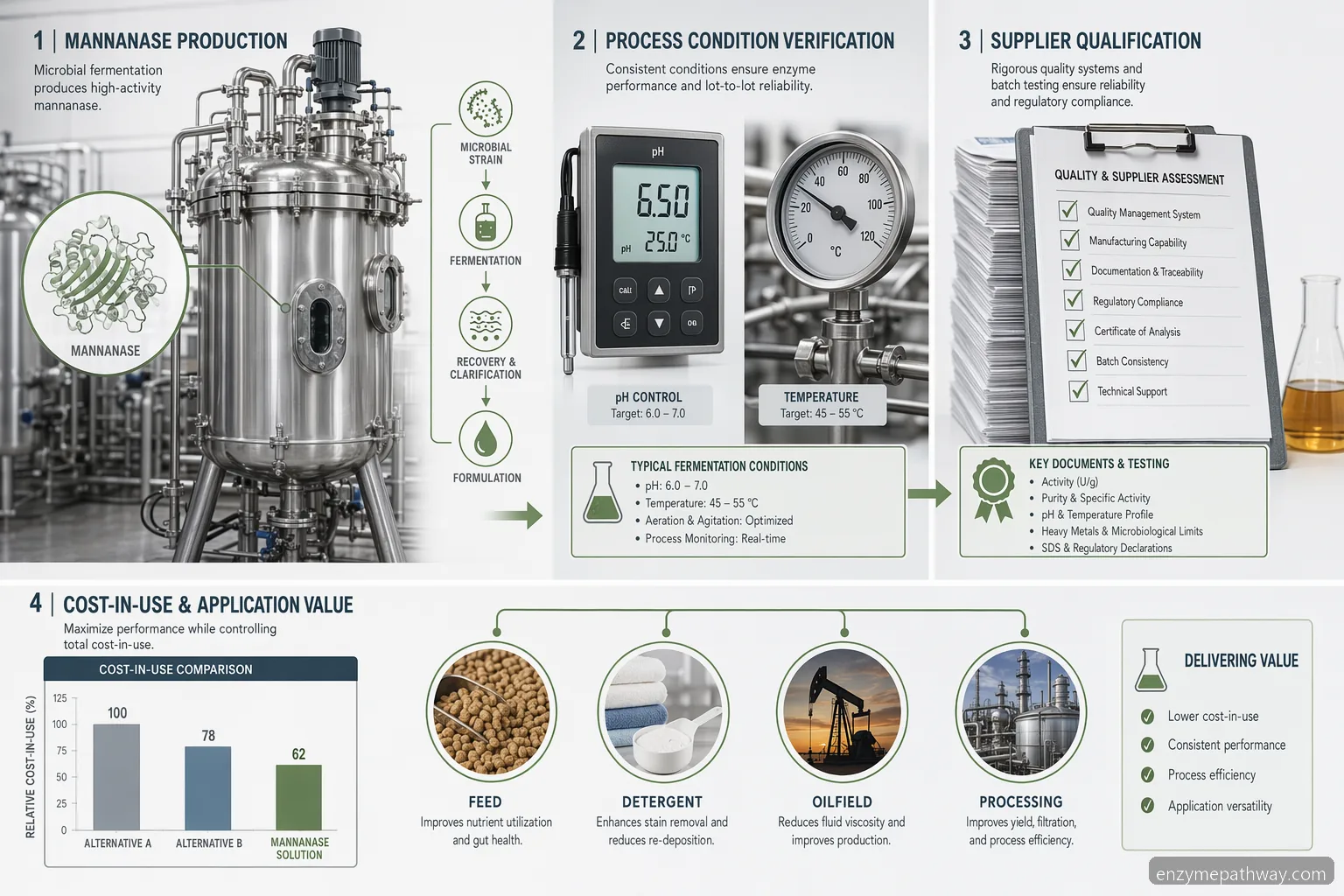
What Industrial Buyers Mean by Mannanase Production
For a purchasing or process team, mannanase production is not only fermentation output; it is the ability to receive a consistent mannanase enzyme that performs in a defined industrial process. Beta-mannanase hydrolyzes beta-1,4-mannan structures found in guar gum, locust bean gum, palm kernel meal, copra meal, coffee extracts, and other hemicellulose-rich materials. In oil drilling, a guar gum enzyme program can reduce viscosity in selected fluid systems. In animal feed, mannanase can support breakdown of non-starch polysaccharides when the enzyme survives pelleting or is applied post-pellet. In detergents, alkaline-compatible mannanase targets mannan-based food soils. In coffee processing, it may improve extractability and filtration. Buyers should define the application first, then compare enzyme activity, formulation, stability, safety documentation, and supplier support against that use case.
Common forms: liquid concentrate, stabilized liquid, powder, or granule • Key substrate fit: guar, galactomannan, glucomannan, or feed mannans • Commercial decision point: performance per kilogram of treated material
Process Conditions to Confirm Before Quoting
A useful mannanase quote starts with process conditions, not only activity units. Many fungal or bacterial mannanase products operate in mildly acidic to neutral ranges, while some detergent or oilfield grades are selected for alkaline or higher-temperature performance. As a practical screening window, buyers often test pH 4.5-7.0 for feed and coffee applications, pH 7.0-10.5 for detergent systems, and the actual drilling-fluid pH used on site. Temperature trials commonly include 30-60°C for processing, 40-75°C for oilfield viscosity work, and pelleting exposure checks for feed enzymes. Dosage bands vary widely, so bench trials may start around 50-500 g per metric ton in feed, 0.05-0.5% in liquid formulations, or ppm-level active enzyme in process water, then adjust by response.
Confirm pH profile, temperature profile, and hold-time stability • Ask whether salts, surfactants, oxidants, or chelants inhibit activity • Run tests on the actual substrate, not only purified locust bean gum
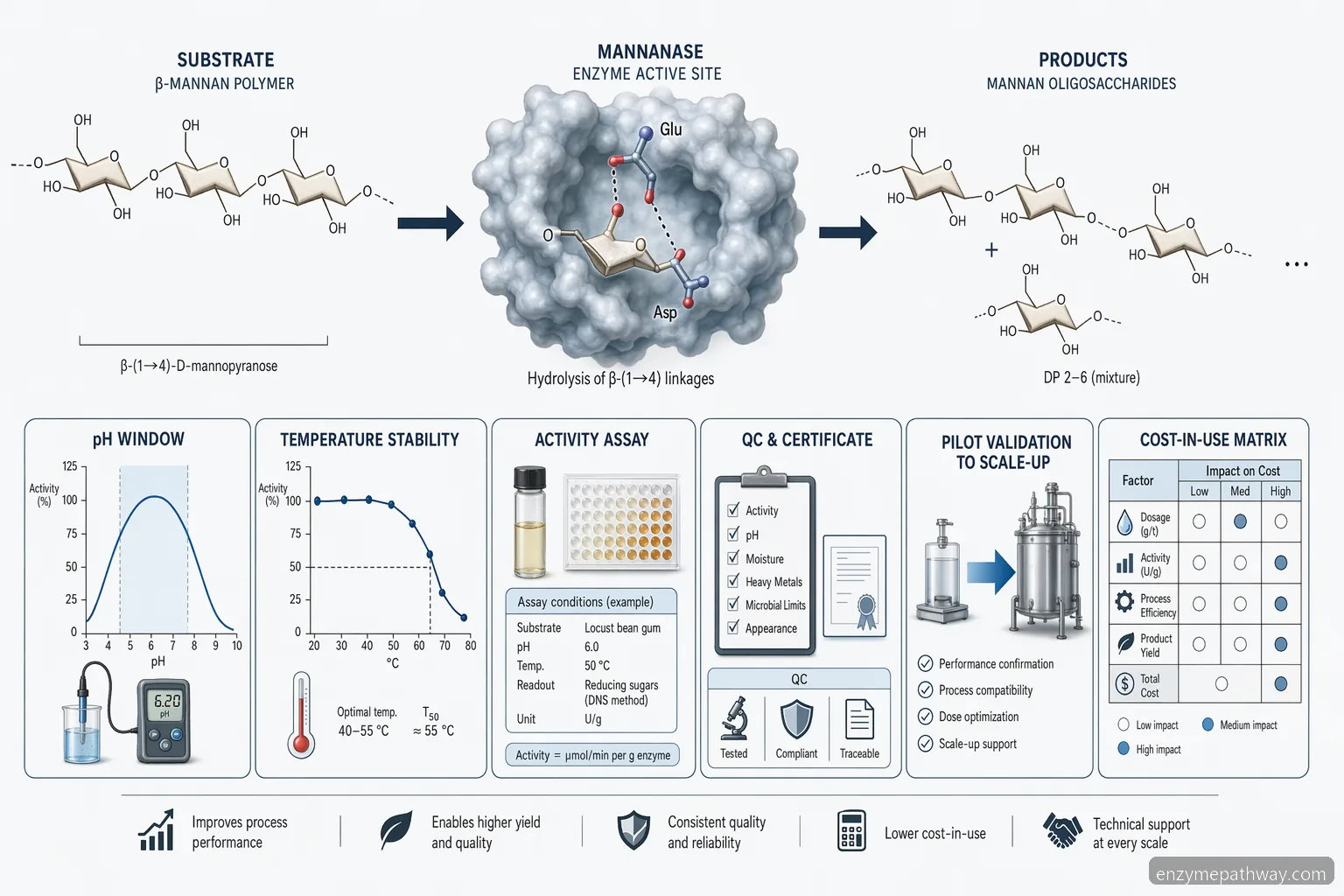
QC Documents and Supplier Qualification
A qualified mannanase supplier should provide a current Certificate of Analysis, Technical Data Sheet, and Safety Data Sheet for the exact grade being evaluated. The COA should state activity, test method reference, appearance, batch number, manufacturing date or retest date, and any relevant microbiological or heavy metal limits where applicable to the market. The TDS should describe formulation, recommended pH and temperature, storage, handling, solubility or dispersibility, and dosage guidance. The SDS should support workplace risk assessment for enzyme dust or aerosol sensitization. During supplier qualification, ask how activity is standardized, how deviations are managed, what packaging options are available, and whether technical service can support pilot trials. Avoid relying on generic claims; compare measurable release specifications, retained samples, stability data, and change-control practices.
Request COA/TDS/SDS before sample approval • Check lot-to-lot activity variation and retest policy • Confirm packaging, shelf life, storage temperature, and lead time • Document notification requirements for formulation or site changes
Pilot Validation and Cost-in-Use
Pilot validation should connect mannanase dose to a business result. In drilling fluids, measure viscosity reduction, break profile, compatibility with salts and additives, and cleanup performance. In animal feed, evaluate retained enzyme activity after processing, substrate level in the diet, performance data from controlled trials, and feed mill handling. In detergents, run stain panels containing mannan-rich soils under target wash pH, temperature, water hardness, and surfactant conditions. In coffee processing, monitor extract yield, viscosity, filtration rate, turbidity, and flavor-related process controls. Cost-in-use is calculated from delivered enzyme cost, required dose, yield gain or processing benefit, waste reduction, and operational impact. The lowest price per kilogram is not always the lowest cost if activity, stability, or technical service is weaker.
Use control, low, medium, and high enzyme dosage trials • Track both technical response and operating cost • Confirm scale-up under real residence time and mixing conditions • Include logistics and inventory carrying cost in comparisons
Sustainable Feedstocks and Technical Screening
Many technical teams are interested in the use of agroindustry wastes for mannanase production or the use of agricultural wastes for mannanase enzyme production, including substrates such as palm kernel cake, copra meal, wheat bran, soybean residues, and other mannan-containing byproducts. These topics are valuable for R&D and sustainability discussions, but industrial buyers should separate research screening from commercial supply qualification. A student poster screening mannanase production from bacteria, a student poster isolation and screeniing mannanase production from bacteria, or a mannanase production from bacteria poster may show interesting strains or media concepts, yet it does not replace validated manufacturing controls, consistent formulation, and application data. When sustainability matters, ask suppliers for feedstock information, waste-minimization practices, yield consistency, and documentation they can substantiate without confidential or unverifiable claims.
Treat academic screening as early-stage evidence, not a purchase specification • Ask for commercial batch data rather than only lab fermentation results • Evaluate sustainability claims through documents and measurable practices
Technical Buying Checklist
Buyer Questions
Compare suppliers using application fit, not only price or headline activity. Request COA, TDS, SDS, assay method, pH and temperature profile, stability data, packaging details, and sample availability. Run pilot trials on your actual substrate and process conditions. Then calculate cost-in-use from delivered price, dosage, process benefit, yield effect, waste reduction, and technical support.
In industrial purchasing, mannanase usually refers to enzymes that hydrolyze mannan-containing polysaccharides. Beta-mannanase more specifically describes endo-beta-1,4-mannanase activity, which cuts beta-1,4 linkages in mannans and galactomannans. Buyers should confirm the supplier’s declared enzyme activity, assay substrate, and application data because different grades can perform differently in feed, detergent, oilfield, and coffee processing conditions.
Use the supplier’s recommendation as the starting point, then bracket it with low, medium, and high dosages. Feed trials may begin around 50-500 g per metric ton depending on potency and diet. Liquid formulations or process aids may be screened around 0.05-0.5% where appropriate. Always adjust by measured response, substrate load, residence time, pH, temperature, and final cost-in-use.
Yes, research often evaluates agricultural or agroindustry residues as fermentation substrates for mannanase production, including mannan-rich byproducts. For commercial buying, however, the key question is whether the supplier can deliver consistent activity, purity, safety documentation, stability, and batch traceability. Sustainability-related feedstock information is useful, but it should be supported by supplier documentation and should not replace application validation.
A student poster screening mannanase production from bacteria can be useful for understanding strain discovery, fermentation variables, or academic trends. It is not enough for purchasing approval. Procurement teams should require commercial samples, COA/TDS/SDS, lot consistency data, application trials, scale-up evidence, and clear supplier quality procedures before approving a mannanase enzyme for production use.
Related Search Themes
mannanase, mannanase enzyme, use of agroindustry wastes for mannanase production, use of agricultural wastes for mannanase enzyme production, student poster screening mannanase production from bacteria, student poster screening mannanase production
Mannanase for Research & Industry
Need Mannanase for your lab or production process?
ISO 9001 certified · Food-grade & research-grade · Ships to 80+ countries
Frequently Asked Questions
How should buyers compare mannanase production suppliers?
Compare suppliers using application fit, not only price or headline activity. Request COA, TDS, SDS, assay method, pH and temperature profile, stability data, packaging details, and sample availability. Run pilot trials on your actual substrate and process conditions. Then calculate cost-in-use from delivered price, dosage, process benefit, yield effect, waste reduction, and technical support.
What is the difference between mannanase and beta-mannanase?
In industrial purchasing, mannanase usually refers to enzymes that hydrolyze mannan-containing polysaccharides. Beta-mannanase more specifically describes endo-beta-1,4-mannanase activity, which cuts beta-1,4 linkages in mannans and galactomannans. Buyers should confirm the supplier’s declared enzyme activity, assay substrate, and application data because different grades can perform differently in feed, detergent, oilfield, and coffee processing conditions.
What dosage of mannanase enzyme should we test first?
Use the supplier’s recommendation as the starting point, then bracket it with low, medium, and high dosages. Feed trials may begin around 50-500 g per metric ton depending on potency and diet. Liquid formulations or process aids may be screened around 0.05-0.5% where appropriate. Always adjust by measured response, substrate load, residence time, pH, temperature, and final cost-in-use.
Can agricultural wastes be used for mannanase enzyme production?
Yes, research often evaluates agricultural or agroindustry residues as fermentation substrates for mannanase production, including mannan-rich byproducts. For commercial buying, however, the key question is whether the supplier can deliver consistent activity, purity, safety documentation, stability, and batch traceability. Sustainability-related feedstock information is useful, but it should be supported by supplier documentation and should not replace application validation.
Are student posters on bacterial mannanase production useful for procurement?
A student poster screening mannanase production from bacteria can be useful for understanding strain discovery, fermentation variables, or academic trends. It is not enough for purchasing approval. Procurement teams should require commercial samples, COA/TDS/SDS, lot consistency data, application trials, scale-up evidence, and clear supplier quality procedures before approving a mannanase enzyme for production use.
Related: Mannanase for Mannan-Rich Process Streams
Turn This Guide Into a Supplier Brief Request a mannanase sample, COA/TDS/SDS package, and pilot-trial support for your production process. See our application page for Mannanase for Mannan-Rich Process Streams at /applications/mannanase-industrial-processing/ for specs, MOQ, and a free 50 g sample.
Contact Us to Contribute