Mannanase Enzyme in Detergent: Specification Checklist for Buyers
Compare mannanase enzyme specs for detergent: activity, pH, temperature, stability, QC, pilot trials, cost-in-use, and supplier qualification.
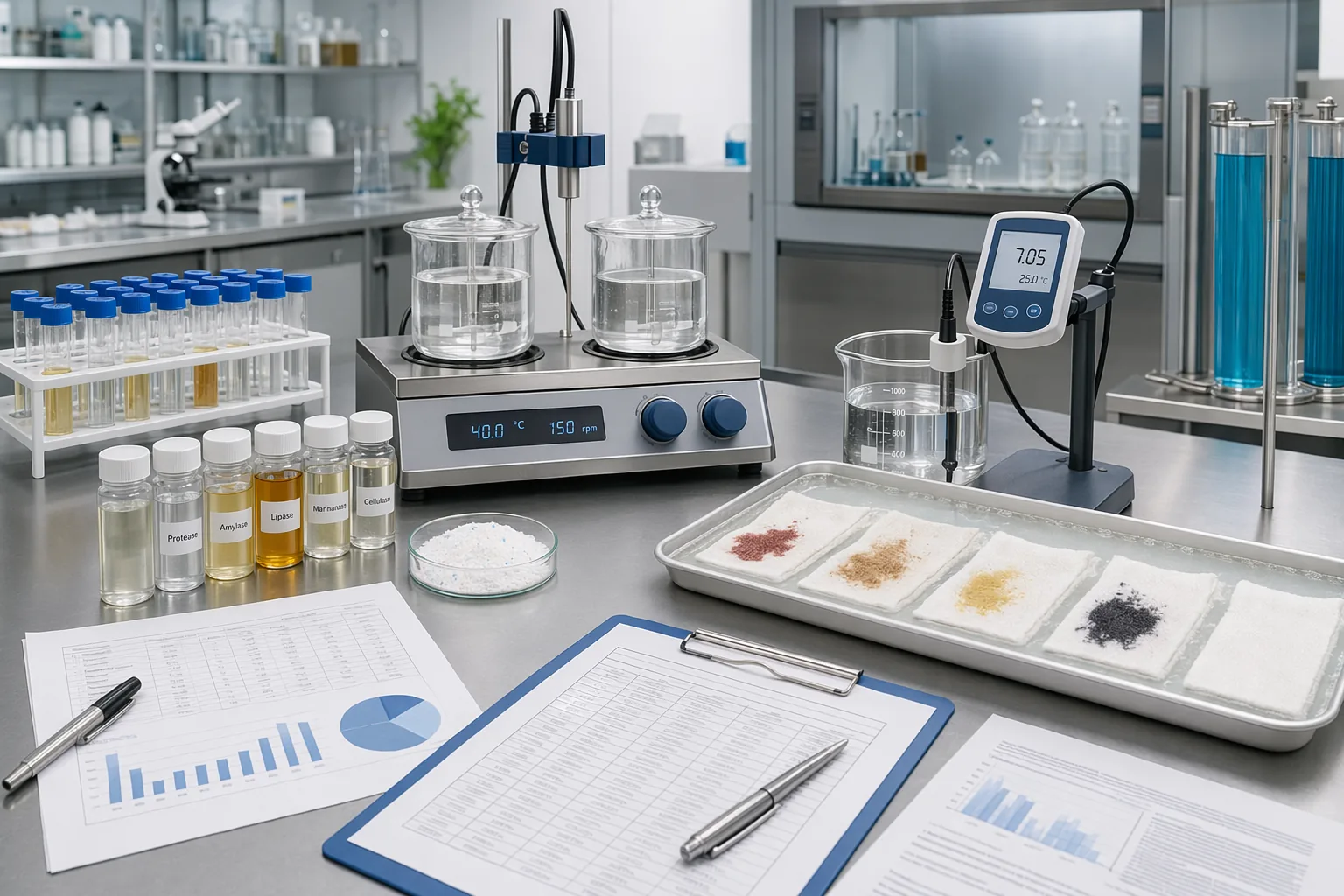
A practical comparison guide for detergent formulators evaluating industrial mannanase enzyme options for laundry and cleaning products.
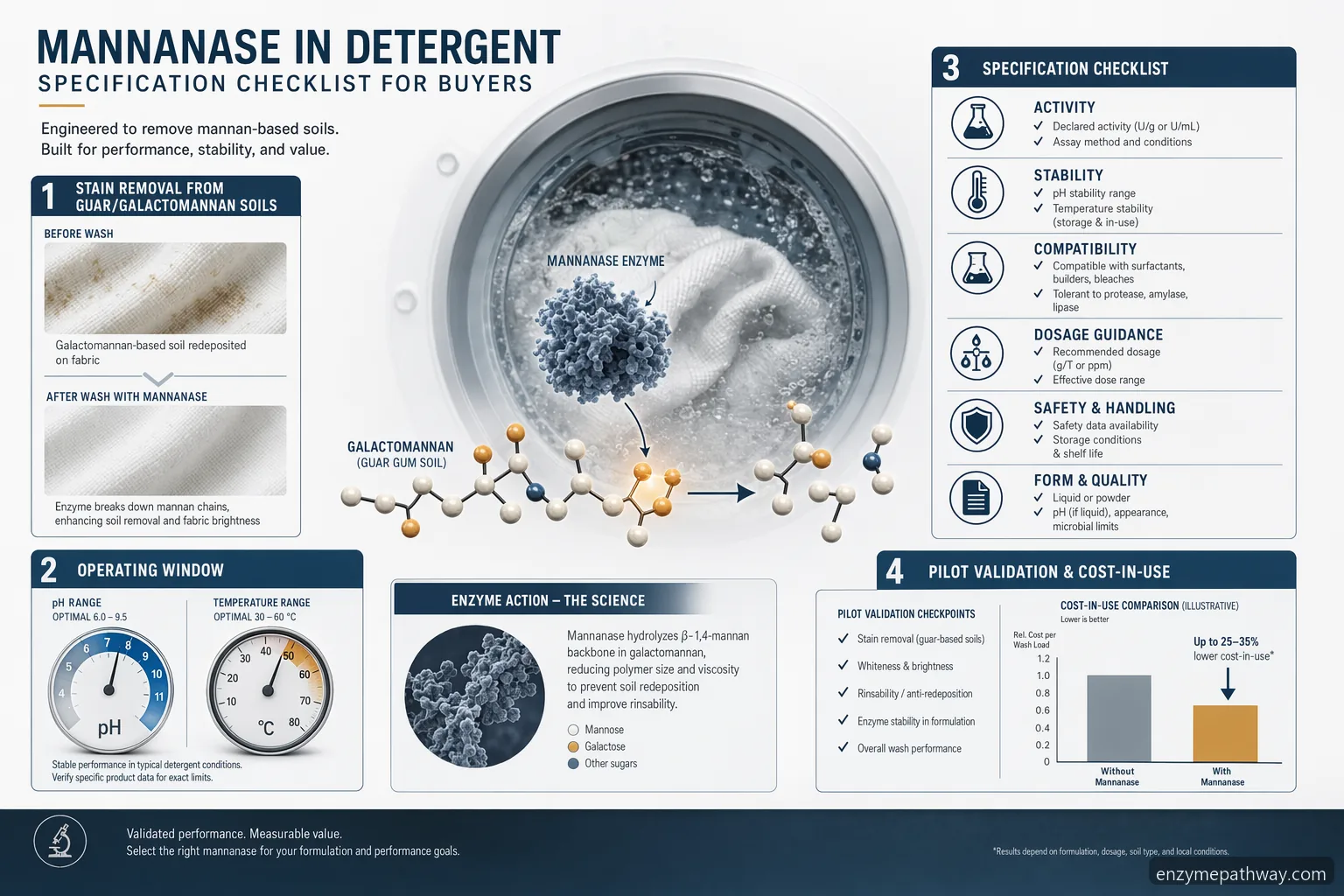
Why mannanase matters in detergent comparison
The use of mannanase enzyme in detergent is driven by its ability to hydrolyze beta-1,4-mannan residues found in guar gum, locust bean gum, and other thickener-based soils. These gums appear in sauces, processed foods, personal care products, and household stains, where they can bind particulate soil and reduce cleaning efficiency. For B2B buyers, the best mannanase enzyme for detergent is not simply the highest-activity product on paper. It is the enzyme that delivers measurable stain removal under the detergent’s pH, wash temperature, surfactant system, builder level, and storage conditions. Liquid laundry detergents, powder detergents, and unit-dose formats may require different stabilization strategies. A detergent-grade beta mannanase enzyme should be compared through application data, not only catalog specifications. The right shortlist should balance performance, formulation robustness, regulatory documentation, supply continuity, and cost-in-use.
Target soils: guar gum, mannan-rich food stains, and hydrocolloid residues. • Main buyer concern: reliable cleaning benefit under real wash conditions. • Best comparison basis: application testing plus documented QC.
Operating conditions to match before selection
Industrial mannanase enzyme detergent performance depends strongly on pH and temperature. Many laundry systems operate from mildly neutral to alkaline conditions, commonly around pH 7.0 to 11.0 in wash liquor. A practical detergent enzyme should retain useful activity across the intended use window rather than only at its laboratory optimum. Wash temperatures may range from cold-water cleaning at 20°C to warm cycles around 40°C and, in some markets, higher temperatures near 60°C. Buyers should ask whether activity curves were generated using detergent-relevant substrates and buffers. Compatibility with anionic and nonionic surfactants, builders, chelants, preservatives, dyes, fragrance components, and other enzymes is also essential. In bleach-containing systems, confirm whether the mannanase is separated, encapsulated, or otherwise protected. A specification that ignores the complete formulation can underestimate deactivation risk.
Typical detergent evaluation pH: 7.0 to 11.0. • Typical wash evaluation temperature: 20°C to 60°C. • Check compatibility with protease, amylase, lipase, cellulase, and bleach systems.
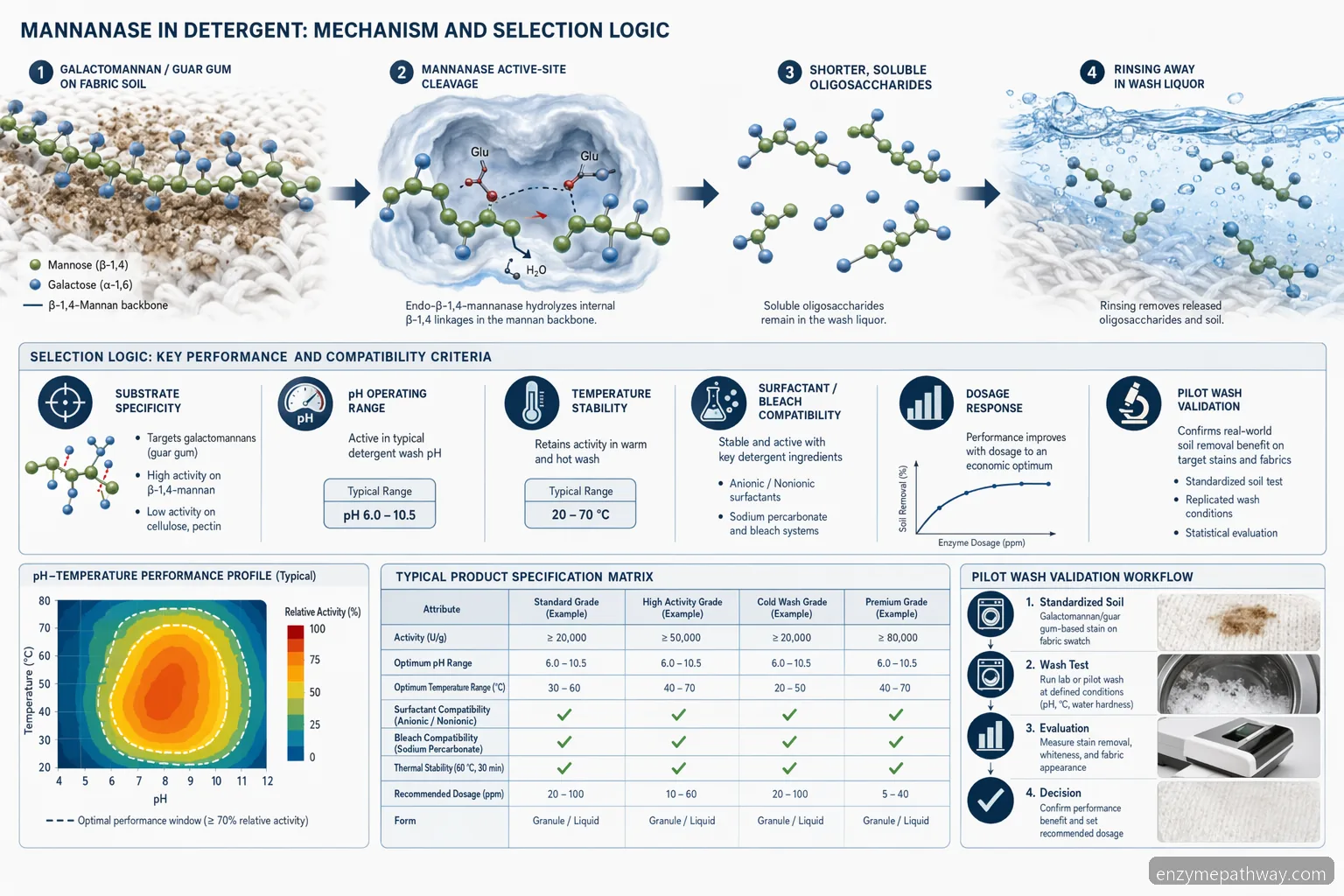
Specification checklist for detergent-grade mannanase
A mannanase enzyme supplier for detergent should provide a technical data sheet that connects product specifications to application performance. Activity units must be clearly defined because enzyme units are method-dependent and cannot always be compared across suppliers. Buyers should request the substrate used, assay pH, assay temperature, reaction time, and calculation method. Physical form is also important: liquid concentrates may suit liquid detergents, while granulated or coated products may be preferred for powders. For liquid detergents, stabilization against water activity, pH drift, preservatives, and surfactants should be reviewed. For powders, dust control, particle integrity, and segregation risk matter. A complete comparison also includes storage stability, recommended handling, shelf life, microbial limits where relevant, and release specifications on the COA. Avoid choosing only by quoted activity; normalize by dosage, retained activity, and stain performance.
Confirm activity method and unit definition. • Compare retained activity after storage, not only initial activity. • Match liquid or granule format to the detergent manufacturing process. • Review COA, TDS, and SDS before pilot purchase.
Pilot validation and cost-in-use evaluation
Pilot validation converts a promising mannanase enzyme into a qualified detergent ingredient. Start with bench screening across realistic dosage bands, such as 50 to 500 ppm enzyme product in wash liquor or 0.02% to 0.20% in finished formulation, depending on activity and supplier recommendation. Use standardized stained swatches containing mannan-rich soils and compare against a no-enzyme control and current benchmark. Measure cleaning by reflectance or image analysis where possible, then confirm through consumer-relevant wash conditions. Formulation stability should be checked after accelerated storage, for example 4 weeks at 35°C to 40°C and freeze-thaw testing where applicable. Cost-in-use should include dosage needed for target cleaning, retained activity after storage, processing losses, freight, minimum order quantity, and waste from expired material. The lowest price per kilogram is rarely the lowest total cost.
Run no-enzyme, benchmark, and candidate comparisons. • Include cold, warm, and target-market wash conditions. • Calculate cost per wash or cost per metric ton of finished detergent. • Confirm performance after storage, not only immediately after blending.
Supplier qualification for industrial detergent buyers
A reliable mannanase enzyme supplier for detergent should support both documentation and scale-up. At minimum, request a current COA for each lot, TDS with recommended application conditions, SDS with safe handling guidance, allergen and occupational exposure precautions, and a statement of composition suitable for your internal review. Supplier qualification should also examine batch consistency, lead time, packaging options, shelf life, sample availability, technical response speed, and ability to troubleshoot formulation instability. Ask whether the supplier can provide pilot quantities from the same manufacturing route used for commercial supply. For recurring production, define change notification expectations, retained sample policy, complaint response process, and traceability documentation. If multiple mannanase sources perform similarly, prioritize the supplier with transparent QC, clear communication, and practical detergent application experience. Documentation quality often predicts scale-up reliability.
Request COA, TDS, SDS, and lot traceability information. • Confirm commercial packaging, shelf life, and storage requirements. • Ask for change notification and complaint handling procedures. • Evaluate technical service, not only quoted price.
Technical Buying Checklist
Buyer Questions
Mannanase enzyme in laundry detergent breaks down mannan-based gums, including guar gum and related hydrocolloids found in processed foods, sauces, and personal care residues. These soils can hold particulate dirt and create stubborn stains. By hydrolyzing the gum structure, mannanase helps the detergent system release soil more effectively. Performance should be verified under the detergent’s pH, temperature, surfactant, and storage conditions.
Compare beta mannanase enzyme activity only when the assay method is clear. Ask each supplier for substrate, assay pH, assay temperature, reaction time, calibration approach, and unit definition. Activity units from different suppliers may not be directly equivalent. For detergent procurement, the better comparison is retained activity and stain removal at the required dosage in your actual formulation after storage.
Dosage depends on enzyme potency, formulation format, target stain claim, storage stability, and wash conditions. Screening often starts with supplier recommendations and may include ranges such as 50 to 500 ppm enzyme product in wash liquor or 0.02% to 0.20% in finished detergent. These are pilot bands, not universal specifications. Final dosage should be based on stain performance, stability, and cost-in-use.
A detergent enzyme supplier should provide a COA for each lot, a TDS with application guidance, an SDS with safe handling instructions, activity method details, storage and shelf-life data, and traceability information. For qualification, buyers should also request formulation compatibility data, sample availability, packaging options, lead time, change notification expectations, and technical support contacts for pilot and commercial scale-up.
Mannanase can be formulated alongside enzymes such as protease, amylase, lipase, and cellulase when compatibility is proven. The risk is not only enzyme-enzyme interaction; surfactants, pH, water activity, preservatives, builders, and oxidants can also reduce stability. Test the full formulation after manufacturing and storage. For powders or bleach systems, coated granules or physical separation may be needed to protect activity.
Mannanase for Research & Industry
Need Mannanase for your lab or production process?
ISO 9001 certified · Food-grade & research-grade · Ships to 80+ countries
Frequently Asked Questions
What does mannanase enzyme do in laundry detergent?
Mannanase enzyme in laundry detergent breaks down mannan-based gums, including guar gum and related hydrocolloids found in processed foods, sauces, and personal care residues. These soils can hold particulate dirt and create stubborn stains. By hydrolyzing the gum structure, mannanase helps the detergent system release soil more effectively. Performance should be verified under the detergent’s pH, temperature, surfactant, and storage conditions.
How should buyers compare beta mannanase enzyme activity?
Compare beta mannanase enzyme activity only when the assay method is clear. Ask each supplier for substrate, assay pH, assay temperature, reaction time, calibration approach, and unit definition. Activity units from different suppliers may not be directly equivalent. For detergent procurement, the better comparison is retained activity and stain removal at the required dosage in your actual formulation after storage.
What dosage of mannanase enzyme is used in detergent?
Dosage depends on enzyme potency, formulation format, target stain claim, storage stability, and wash conditions. Screening often starts with supplier recommendations and may include ranges such as 50 to 500 ppm enzyme product in wash liquor or 0.02% to 0.20% in finished detergent. These are pilot bands, not universal specifications. Final dosage should be based on stain performance, stability, and cost-in-use.
What documents should a mannanase enzyme supplier provide?
A detergent enzyme supplier should provide a COA for each lot, a TDS with application guidance, an SDS with safe handling instructions, activity method details, storage and shelf-life data, and traceability information. For qualification, buyers should also request formulation compatibility data, sample availability, packaging options, lead time, change notification expectations, and technical support contacts for pilot and commercial scale-up.
Can mannanase be used with other detergent enzymes?
Mannanase can be formulated alongside enzymes such as protease, amylase, lipase, and cellulase when compatibility is proven. The risk is not only enzyme-enzyme interaction; surfactants, pH, water activity, preservatives, builders, and oxidants can also reduce stability. Test the full formulation after manufacturing and storage. For powders or bleach systems, coated granules or physical separation may be needed to protect activity.
Related: Mannanase for Mannan-Rich Process Streams
Turn This Guide Into a Supplier Brief Request detergent-grade mannanase samples, COA/TDS/SDS review, and pilot support from Enzyme Pathway. See our application page for Mannanase for Mannan-Rich Process Streams at /applications/mannanase-industrial-processing/ for specs, MOQ, and a free 50 g sample.
Contact Us to Contribute