Mannanase Application in Oil Drilling
Apply mannanase enzyme in oil drilling fluids to manage guar-based polymers, with pH, temperature, dosage, QC, pilot validation, and buying guidance.
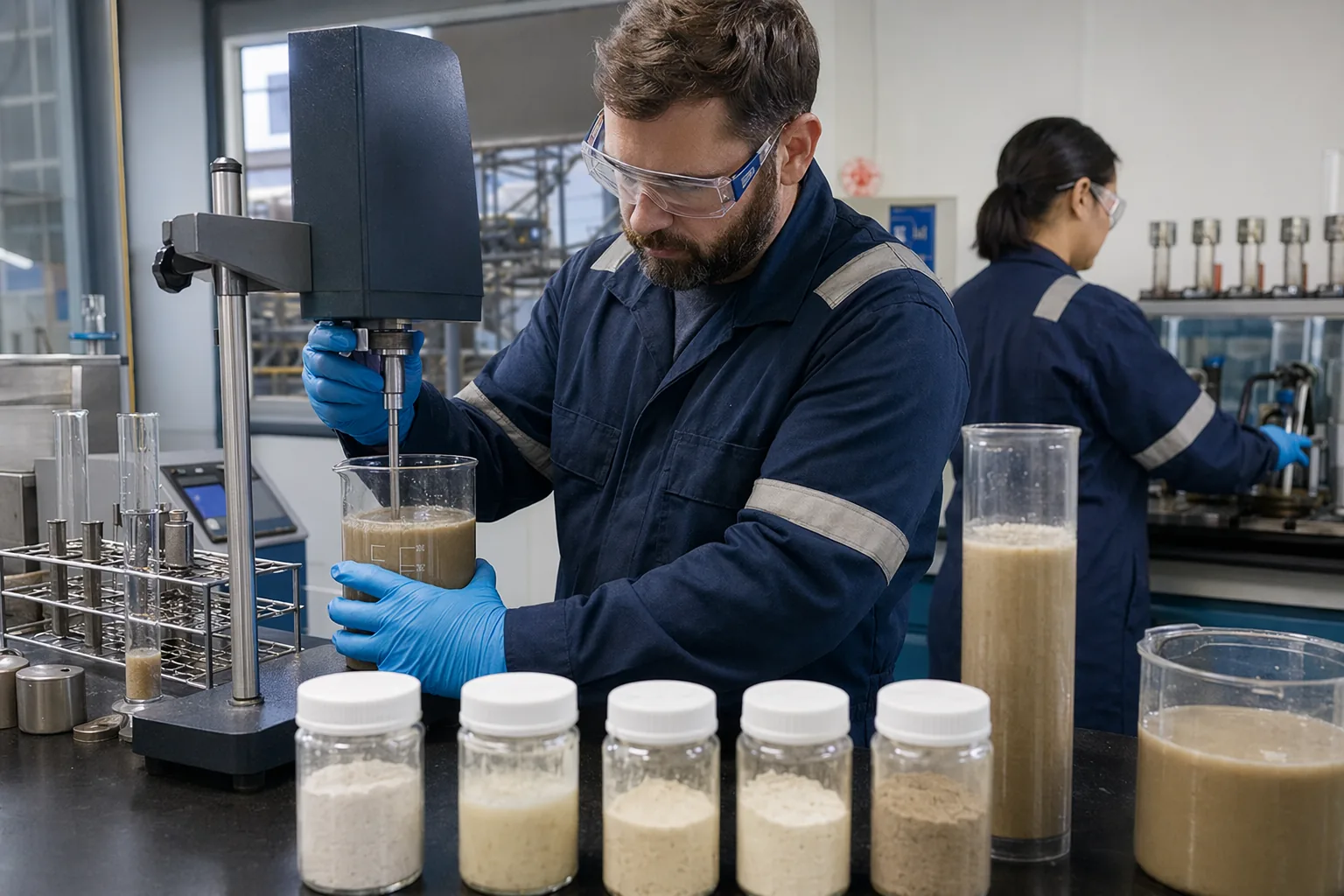
A practical B2B guide to using mannanase enzyme for controlled viscosity reduction, guar residue cleanup, and cost-in-use evaluation in oilfield fluid programs.
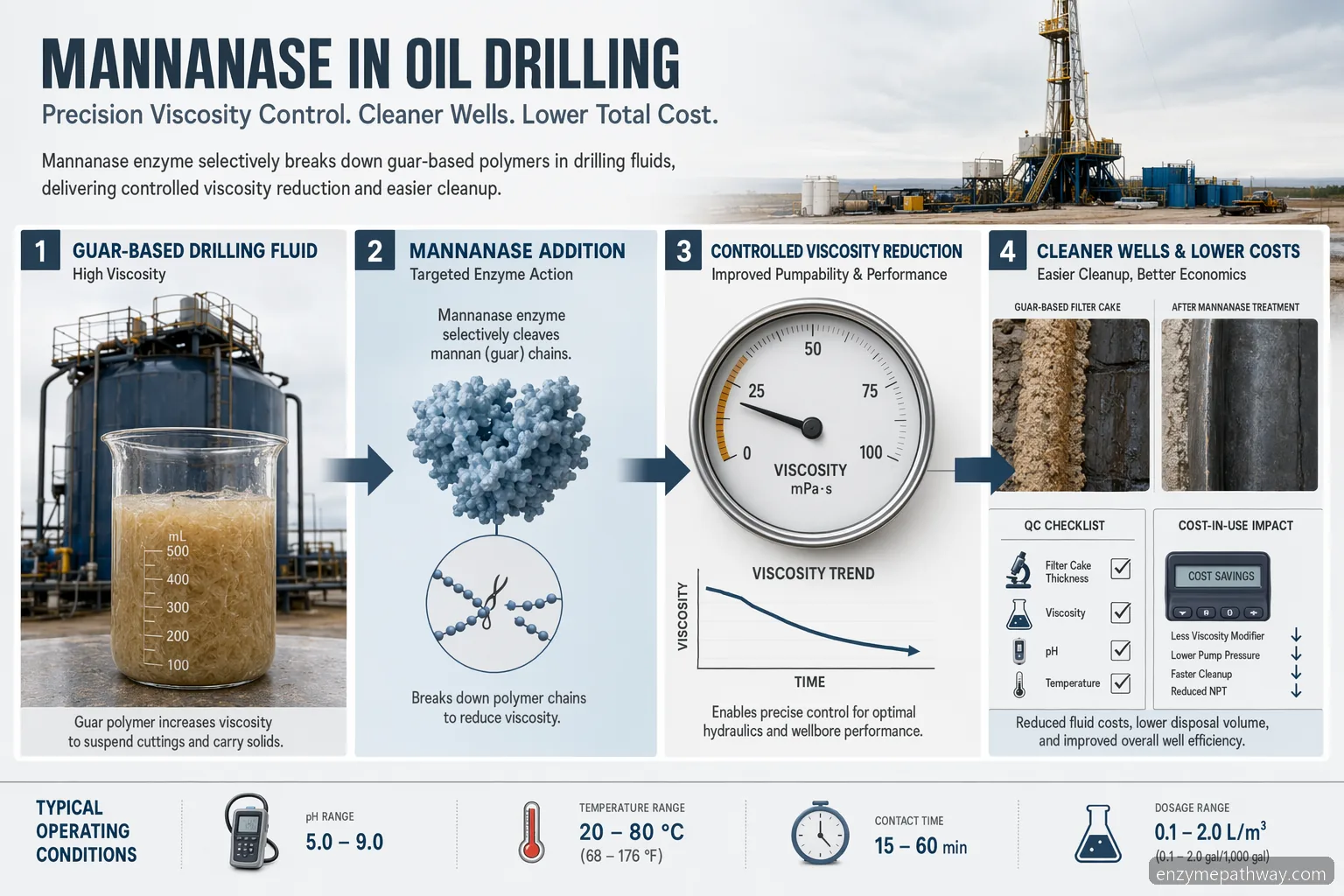
Where Mannanase Fits in Oilfield Fluid Programs
Mannanase, also called beta-mannanase or beta mannanase enzyme, hydrolyzes the beta-1,4-mannan backbone found in guar gum and other galactomannan polymers. In oil drilling and completion operations, the mannanase application is mainly polymer viscosity reduction, filter-cake cleanup, and removal of guar-based residues that can restrict permeability. It is most relevant where guar gum, hydroxypropyl guar, or related viscosifiers are used in water-based fluids. Unlike nonspecific chemical breakers, a mannanase enzyme is selected for substrate specificity and can be evaluated under defined pH, temperature, salinity, and contact-time conditions. It should not be treated as a universal breaker for all drilling-fluid additives; xanthan, cellulose derivatives, starch, and synthetic polymers require different chemistries or enzyme classes. For buyers, the practical question is whether the enzyme provides controlled degradation under actual field conditions without destabilizing the fluid before its intended function is complete.
Primary target: guar and galactomannan polymers • Typical roles: viscosity break, residue cleanup, filter-cake treatment • Best fit: water-based systems containing mannan-rich polymers
Process Conditions to Define Before Selection
A supplier cannot recommend a reliable dosage until the operating window is defined. Start with fluid pH, bottomhole or circulating temperature, polymer concentration, brine composition, shear history, and required break time. Many industrial mannanase products are screened around pH 5.0 to 9.0 and 25 to 80°C, but the useful range depends on the strain, formulation, stabilizers, and exposure time. Some beta-mannanase products tolerate moderate salinity, while high divalent ions, oxidizers, biocides, or extreme pH may reduce activity. In field design, confirm whether the enzyme must act during circulation, after placement, or during a delayed cleanup stage. If delayed action is required, evaluate encapsulation, staged addition, or temperature-triggered release options only after laboratory confirmation. The goal is not maximum activity in a catalog test; it is predictable performance in the selected oilfield fluid.
Define pH, temperature, salinity, and target break time • Check compatibility with biocides, surfactants, crosslinkers, and breakers • Use field-matched water and polymer, not only lab-grade substrates
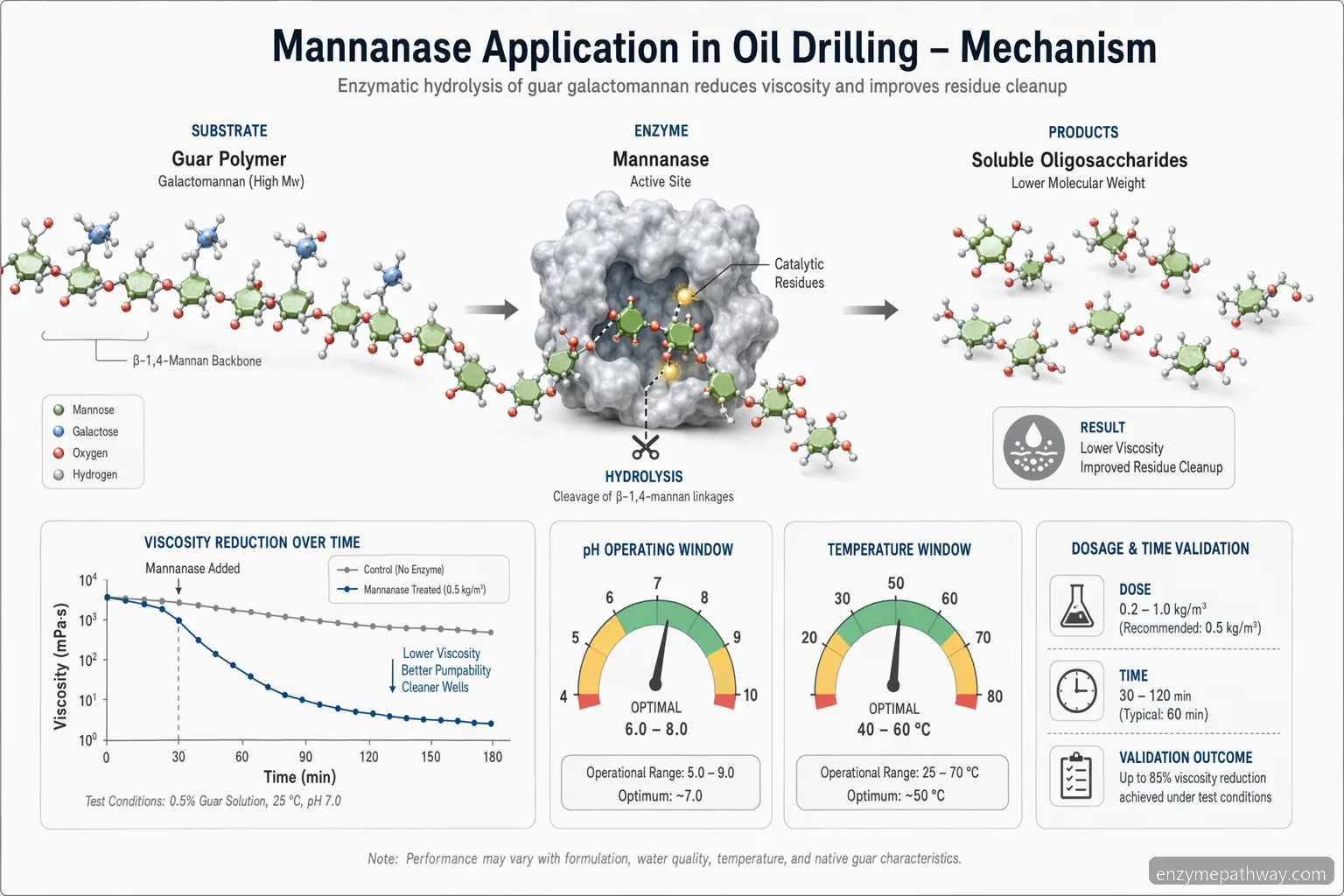
Dosage Bands and Addition Strategy
Initial screening dosages for mannanase in oil drilling fluids commonly begin in the range of 0.05 to 2.0 kg of liquid or powder product per metric ton of treated fluid, or an equivalent activity-based dose supplied by the manufacturer. The correct band depends on enzyme activity units, guar concentration, temperature, residence time, and acceptable residual viscosity. For precise procurement, specify activity units per gram or milliliter, the assay substrate, assay pH, assay temperature, and batch-to-batch activity tolerance. Add the mannanase enzyme where mixing energy can disperse it evenly without prolonged exposure to incompatible concentrates. Avoid direct contact with strong oxidizers, highly alkaline concentrates, or undiluted biocides unless compatibility has been proven. For high-value wells, compare low, mid, and high doses in a pilot matrix and select the lowest dose that meets cleanup and viscosity targets.
Screen by activity, not only product weight • Run low, medium, and high dose curves • Select dosage using cost-in-use and technical performance together
Laboratory QC and Pilot Validation
Before field use, validate the mannanase application with a lab plan that reflects real fluid chemistry. Minimum QC checks include enzyme activity confirmation from the COA, viscosity reduction versus time, pH drift, retained activity after heat exposure, compatibility with salts and additives, and visual inspection for precipitation or phase separation. Use rotational viscometry at relevant shear rates, temperature-controlled aging cells, and residue or filtrate testing where formation damage is a concern. If the fluid contains mixed polymers, compare beta mannanase alone against combined enzyme or chemical programs. A practical pilot should include untreated control, chemical breaker control, and at least three mannanase dose levels. The decision point is not simply fastest viscosity loss; it is whether the treatment produces controlled break timing, acceptable cleanup, and no adverse interaction with the drilling or completion plan.
Confirm COA activity against an agreed assay • Measure viscosity at field-relevant temperature and shear • Include untreated and conventional breaker controls • Document residue, filtrate, and compatibility observations
Procurement, Documentation, and Supplier Qualification
Industrial buyers should qualify mannanase suppliers with both technical and commercial criteria. Request the COA for each lot, TDS for recommended use conditions, SDS for safe handling, product shelf-life statement, storage requirements, packaging options, activity assay description, and sample availability for pilot work. Ask whether the supplier can provide retained samples, lot traceability, change notification, and reasonable lead-time commitments. Avoid relying on broad claims such as “high activity” unless the activity unit and assay method are disclosed. For field deployment, confirm whether the product is liquid or powder, whether it needs temperature-controlled storage, and how long it remains stable after dilution. Supplier qualification should also include communication speed, ability to support troubleshooting, and willingness to review your fluid recipe under confidentiality. The best source is one that supports repeatable cost-in-use, not just a low unit price.
Request COA, TDS, SDS, activity method, and storage guidance • Verify lot traceability and batch consistency • Evaluate technical support and sample responsiveness
Cost-in-Use and Cross-Application Context
Mannanase is used beyond oilfield fluids, including detergent, animal feed, and coffee processing, but oil drilling demands a different validation standard. Searches for mannanase in laundry detergent or performance of mannanase in laundry application often focus on stain removal from guar-containing food soils at wash pH and consumer-product temperatures. The common misspelling “perfomance of mannanase in laundry application” appears in search data, but those use conditions should not be copied into oilfield design. In drilling, cost-in-use should account for enzyme dosage, activity retention, mixing method, cleanup effectiveness, reduced remedial treatment risk, logistics, and waste-handling implications. Compare mannanase against conventional breakers using the same fluid recipe and operational timeline. If the enzyme enables a lower total treatment cost while meeting viscosity and residue specifications, it becomes a defensible procurement choice.
Do not transfer detergent data directly to oilfield fluids • Evaluate total treatment cost, not only enzyme price • Benchmark against current chemical breaker practice
Technical Buying Checklist
Buyer Questions
The main mannanase application is controlled degradation of guar and related galactomannan polymers used as viscosifiers or fluid-loss components. By hydrolyzing the mannan backbone, mannanase can reduce viscosity and help remove polymer residue. It is most useful when the fluid actually contains guar-based chemistry; it is not a universal breaker for starch, xanthan, cellulose, or synthetic polymers.
Begin with a laboratory dose-response matrix rather than a fixed catalog dosage. Use the actual field fluid, brine, polymer concentration, pH, temperature, and target contact time. Screen low, medium, and high levels, such as 0.05 to 2.0 kg product per metric ton of fluid or an activity-equivalent range. Select the lowest dose that meets viscosity, residue, and timing requirements.
Request a current COA for the lot, TDS, SDS, activity assay method, shelf-life statement, storage guidance, packaging options, and sample availability. For supplier qualification, also ask about lot traceability, retained samples, change notification, lead times, and technical support. These documents help connect the beta-mannanase specification to actual cost-in-use and field reliability.
Not reliably. The performance of mannanase in laundry application is usually tested under wash conditions, consumer detergent chemistry, and guar-containing stain models. Oil drilling fluids involve different polymers, salinity, temperature, shear, additives, and required break timing. Detergent information can show general enzyme capability, but oilfield selection needs separate compatibility testing and pilot validation.
Related Search Themes
mannanase, mannanase enzyme, performance of mannanase in laundry application, perfomance of mannanase in laundry application, mannanase in laundry detergent, beta mannanase
Mannanase for Research & Industry
Need Mannanase for your lab or production process?
ISO 9001 certified · Food-grade & research-grade · Ships to 80+ countries
Frequently Asked Questions
What is the main mannanase application in oil drilling?
The main mannanase application is controlled degradation of guar and related galactomannan polymers used as viscosifiers or fluid-loss components. By hydrolyzing the mannan backbone, mannanase can reduce viscosity and help remove polymer residue. It is most useful when the fluid actually contains guar-based chemistry; it is not a universal breaker for starch, xanthan, cellulose, or synthetic polymers.
How should dosage for mannanase enzyme be selected?
Begin with a laboratory dose-response matrix rather than a fixed catalog dosage. Use the actual field fluid, brine, polymer concentration, pH, temperature, and target contact time. Screen low, medium, and high levels, such as 0.05 to 2.0 kg product per metric ton of fluid or an activity-equivalent range. Select the lowest dose that meets viscosity, residue, and timing requirements.
What documents should an industrial buyer request from a mannanase supplier?
Request a current COA for the lot, TDS, SDS, activity assay method, shelf-life statement, storage guidance, packaging options, and sample availability. For supplier qualification, also ask about lot traceability, retained samples, change notification, lead times, and technical support. These documents help connect the beta-mannanase specification to actual cost-in-use and field reliability.
Can detergent data predict mannanase performance in oil drilling?
Not reliably. The performance of mannanase in laundry application is usually tested under wash conditions, consumer detergent chemistry, and guar-containing stain models. Oil drilling fluids involve different polymers, salinity, temperature, shear, additives, and required break timing. Detergent information can show general enzyme capability, but oilfield selection needs separate compatibility testing and pilot validation.
Related: Mannanase for Mannan-Rich Process Streams
Turn This Guide Into a Supplier Brief Request a mannanase sample, COA/TDS/SDS review, and pilot dosing plan for your oilfield fluid. See our application page for Mannanase for Mannan-Rich Process Streams at /applications/mannanase-industrial-processing/ for specs, MOQ, and a free 50 g sample.
Contact Us to Contribute