Mannanase in Laundry Detergent Formulations
B2B guide to mannanase in laundry detergent: pH, temperature, dosage, QC, pilot trials, COA/TDS/SDS, and supplier checks.

A practical B2B guide for formulators evaluating beta-mannanase in liquid laundry detergents, including process conditions, compatibility checks, pilot validation, and cost-in-use review.
Why formulators use mannanase in detergent
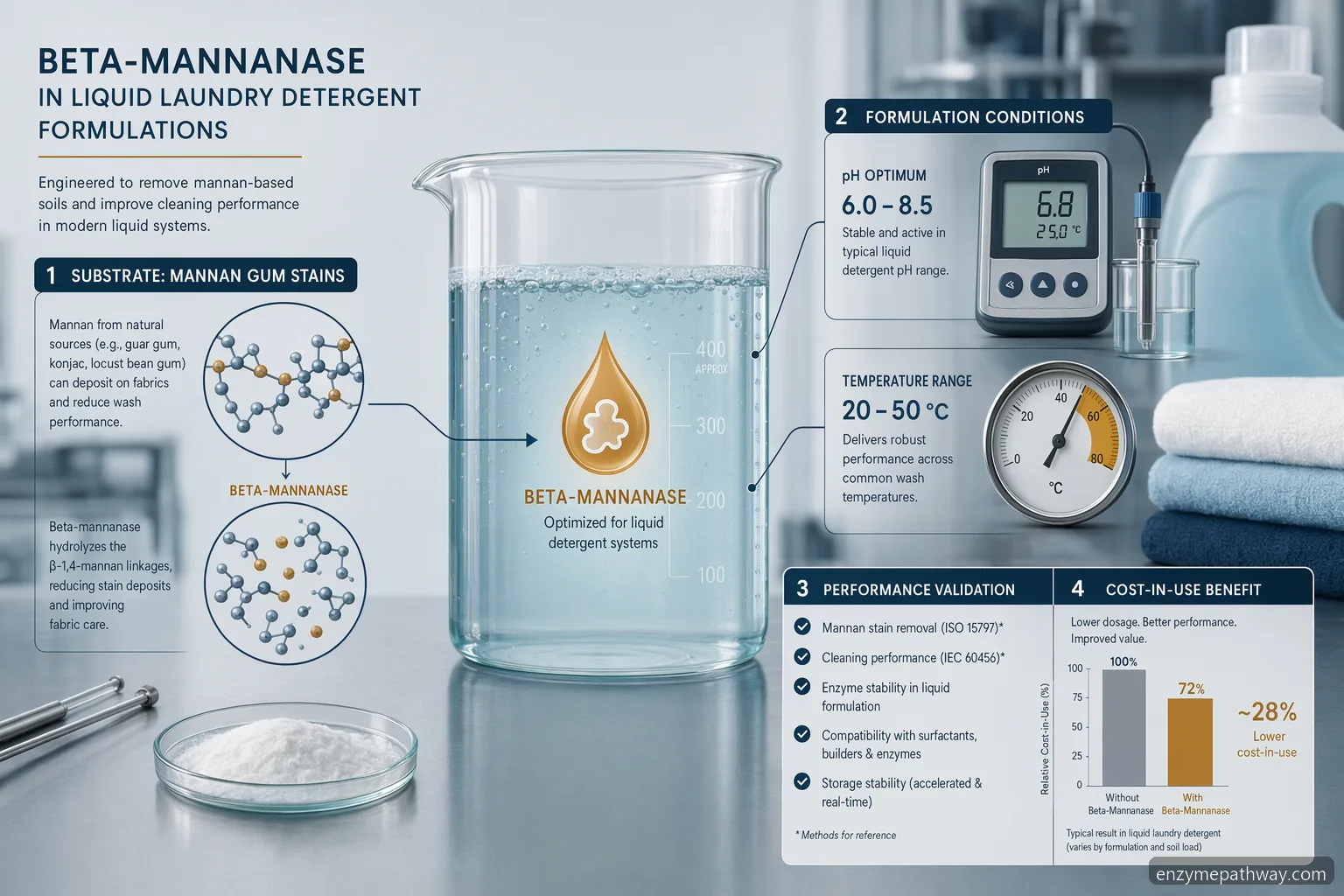
Mannanase, often specified as beta-mannanase, hydrolyzes beta-1,4-mannan structures found in guar gum, locust bean gum, and related hydrocolloids. In laundry applications, these residues may come from processed foods, personal care products, thickeners, or soil redeposition. A fluorescent diagram for a liquid detergent with mannanase typically illustrates enzyme diffusion into a hydrated stain, cleavage of mannan chains, and improved soil release during mechanical agitation. For B2B detergent teams, the value is not a marketing claim by itself; it must be shown through controlled stain-removal tests, storage stability, and compatibility with the full formulation. Mannanase in detergent is usually evaluated alongside protease, amylase, lipase, cellulase, and anti-redeposition polymers. The goal is balanced performance at realistic wash temperatures, water hardness, product dosage, and consumer use conditions.
Targets mannan-rich gums and food-derived thickeners • Useful in liquid and unit-dose detergent development • Best assessed by stain-panel and wash-cycle testing
Formulation conditions for liquid laundry systems
Initial screening for mannanase enzyme laundry formulations commonly uses wash pH ranges of 7.0–10.5 and temperatures of 20–45°C, depending on target markets and wash habits. Concentrated liquid detergents may present harsher storage conditions than the wash liquor because of high surfactant concentration, limited free water, solvents, alkalinity, and preservatives. Formulators should test enzyme activity after storage at ambient conditions and accelerated conditions such as 35–40°C for several weeks, using the supplier’s activity assay where possible. Dosage work is normally expressed as enzyme activity per gram of finished detergent or ppm active enzyme in wash liquor, then converted to cost-in-use. A safe screening approach is to run a dosage ladder rather than assume linear performance. Confirm that the mannanase remains compatible with nonionic and anionic surfactants, builders, chelants, optical brighteners, fragrance, dyes, and any enzyme stabilizer package.
Screen wash pH: 7.0–10.5 • Typical wash temperature range: 20–45°C • Run dosage ladders before commercial scale-up • Verify storage stability in the finished liquid matrix
How a fluorescent diagram supports R&D communication
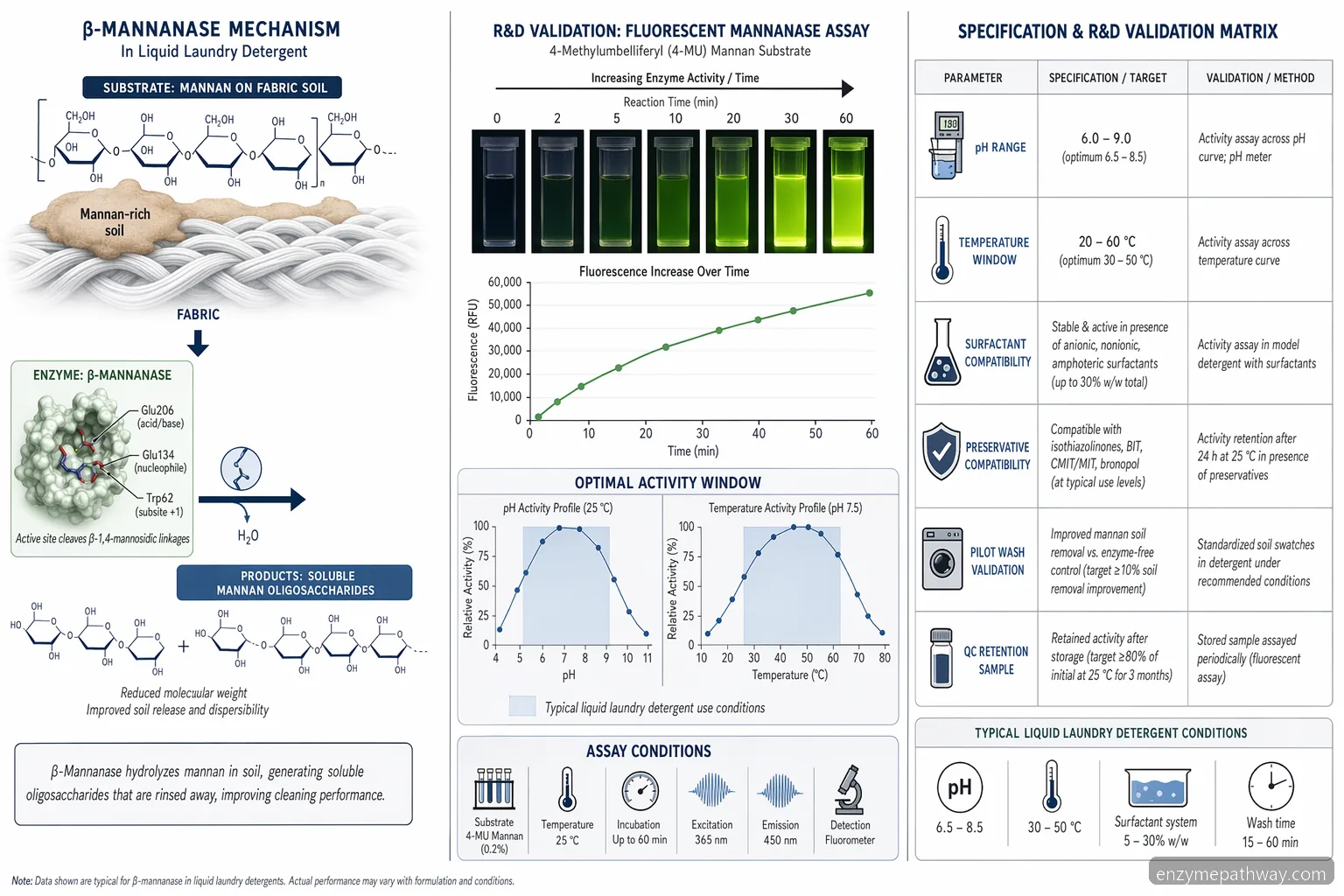
A fluorescent diagram is useful for explaining mechanism, but it should not replace laboratory evidence. In a technical detergent presentation, fluorescent staining can show where mannan-rich soil remains on fabric before washing and how signal intensity changes after treatment with a mannanase-containing liquid detergent. The most credible diagrams pair visual microscopy or imaging with quantitative results, such as percent stain removal, whiteness index, residual fluorescence, or image-analysis data. Keep test conditions transparent: fabric type, soil recipe, enzyme dosage, detergent concentration, water hardness, pH, temperature, wash time, and rinse process. For procurement and formulation teams, this documentation helps connect enzyme mechanism with measurable performance. It also prevents overreliance on a simplified image, because real detergency depends on surfactants, builders, agitation, water chemistry, and mixed soils.
Use diagrams to explain, not prove, performance • Pair fluorescence with quantitative stain data • Document wash conditions and image-analysis method
Pilot validation and quality control checks
Before approving mannanase in laundry detergent, run bench, pilot, and line-trial validation. Bench studies should include enzyme activity recovery in the finished liquid, stain removal versus a control formula, color and odor stability, viscosity drift, phase separation, and microbial preservation checks. Pilot batches should be made with the intended addition point, mixing shear, temperature, and hold time. Many enzyme liquids are best added during cool-down or late-stage blending to reduce thermal and chemical stress, but the supplier’s TDS should guide handling. QC should verify appearance, pH, viscosity, density, enzyme activity, and retained performance after accelerated storage. Packaging compatibility is also important because water activity, headspace, and container materials can influence long-term stability. A practical approval package includes a control formula, enzyme-containing formula, storage samples, wash data, and cost-in-use summary.
Check pH, viscosity, density, appearance, and enzyme activity • Compare against a no-enzyme control • Confirm stability after accelerated and ambient storage • Validate addition point and mixing conditions at pilot scale
Supplier qualification and buying criteria
Industrial enzyme purchasing should combine technical fit, regulatory documentation, supply reliability, and commercial value. Request a current COA for each lot, a TDS describing activity, dosage guidance, storage, handling, and formulation limits, and an SDS covering safe industrial use. Ask for the activity assay method so incoming QC can compare lots consistently. Supplier qualification should also review manufacturing consistency, lead time, change-control practices, allergen and dust-control handling guidance, packaging options, and technical support for pilot validation. Avoid approving a mannanase solely on unit price; cost-in-use depends on activity concentration, stability in your detergent, required dosage, logistics, and performance at the target wash conditions. The best supplier is the one that helps convert enzyme activity into reliable detergent performance at scale.
Request COA, TDS, SDS, and activity method • Evaluate cost-in-use, not only price per kilogram • Confirm lead time, packaging, and change-control support • Require pilot data before full commercial approval
Technical Buying Checklist
Buyer Questions
Mannanase breaks down mannan-based gums and thickeners that can bind stains to fabric or contribute to soil redeposition. In detergent development, it is used to improve removal of selected food and gum-derived residues under realistic wash conditions. Performance should be confirmed with controlled stain panels, defined water hardness, target pH, wash temperature, and comparison against a no-mannanase control.
Start with an activity-based dosage ladder recommended by the enzyme supplier rather than a fixed weight percentage. Screening should include low, medium, and high levels in the finished detergent and then calculate ppm active enzyme in the wash liquor. The correct choice depends on enzyme activity, storage stability, wash pH, temperature, stain type, and cost-in-use targets.
Yes, mannanase is often evaluated with protease, amylase, lipase, cellulase, or pectinase, but compatibility cannot be assumed. Enzymes may affect each other through proteolysis, formulation stress, or storage instability. Run activity-recovery tests, accelerated storage, and wash trials for the complete enzyme package, not only the individual enzyme in buffer.
B2B buyers should request a certificate of analysis, technical data sheet, safety data sheet, activity assay method, recommended storage conditions, shelf-life guidance, and lot traceability. For supplier qualification, also review change-control practices, packaging formats, lead times, technical support, and pilot-trial availability. These documents support incoming QC, safe handling, and consistent detergent formulation.
Fluorescent diagrams can help visualize mannan-rich residue on fabric before and after washing, but they should be supported by quantitative data. Include image-analysis results, stain-removal scores, whiteness or brightness measurements, and full wash conditions. This makes the diagram a technical communication tool rather than an unsupported performance claim.
Related Search Themes
new liquid tide w mannanase fluorescent diagram, new liquid tide w mannanase diagram, mannanase in laundry detergent, mannanase, new liquid tide with mannanase, new liquid tide w mannanase
Mannanase for Research & Industry
Need Mannanase for your lab or production process?
ISO 9001 certified · Food-grade & research-grade · Ships to 80+ countries
Frequently Asked Questions
What does mannanase do in laundry detergent?
Mannanase breaks down mannan-based gums and thickeners that can bind stains to fabric or contribute to soil redeposition. In detergent development, it is used to improve removal of selected food and gum-derived residues under realistic wash conditions. Performance should be confirmed with controlled stain panels, defined water hardness, target pH, wash temperature, and comparison against a no-mannanase control.
What dosage of mannanase should a detergent formulator test?
Start with an activity-based dosage ladder recommended by the enzyme supplier rather than a fixed weight percentage. Screening should include low, medium, and high levels in the finished detergent and then calculate ppm active enzyme in the wash liquor. The correct choice depends on enzyme activity, storage stability, wash pH, temperature, stain type, and cost-in-use targets.
Can mannanase be used with other detergent enzymes?
Yes, mannanase is often evaluated with protease, amylase, lipase, cellulase, or pectinase, but compatibility cannot be assumed. Enzymes may affect each other through proteolysis, formulation stress, or storage instability. Run activity-recovery tests, accelerated storage, and wash trials for the complete enzyme package, not only the individual enzyme in buffer.
Which documents should buyers request from a mannanase supplier?
B2B buyers should request a certificate of analysis, technical data sheet, safety data sheet, activity assay method, recommended storage conditions, shelf-life guidance, and lot traceability. For supplier qualification, also review change-control practices, packaging formats, lead times, technical support, and pilot-trial availability. These documents support incoming QC, safe handling, and consistent detergent formulation.
How should fluorescent diagrams be used in enzyme detergent R&D?
Fluorescent diagrams can help visualize mannan-rich residue on fabric before and after washing, but they should be supported by quantitative data. Include image-analysis results, stain-removal scores, whiteness or brightness measurements, and full wash conditions. This makes the diagram a technical communication tool rather than an unsupported performance claim.
Related: Mannanase for Mannan-Rich Process Streams
Turn This Guide Into a Supplier Brief Request mannanase samples, COA/TDS/SDS, and pilot formulation support for your liquid detergent program. See our application page for Mannanase for Mannan-Rich Process Streams at /applications/mannanase-industrial-processing/ for specs, MOQ, and a free 50 g sample.
Contact Us to Contribute