Mannanase in Detergent: Dosage, pH, and Temperature Troubleshooting
Troubleshoot mannanase in laundry detergent: dosage, pH, temperature, stability, QC checks, COA/TDS/SDS, pilots, and suppliers.
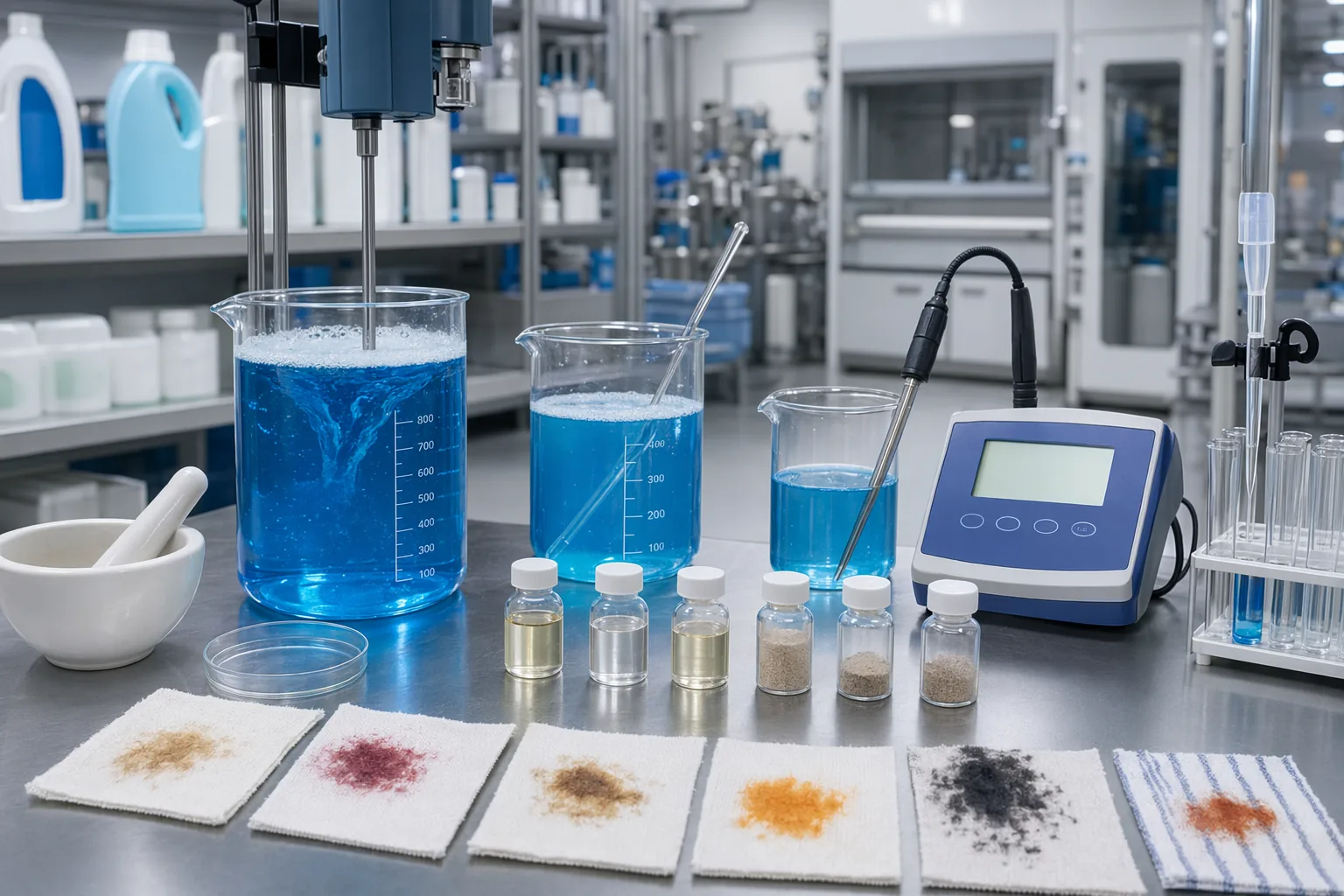
For detergent formulators, beta-mannanase can improve removal of galactomannan-based soils such as guar, locust bean gum, and food thickeners when dosage, pH, temperature, and storage stability are validated in the final formulation.
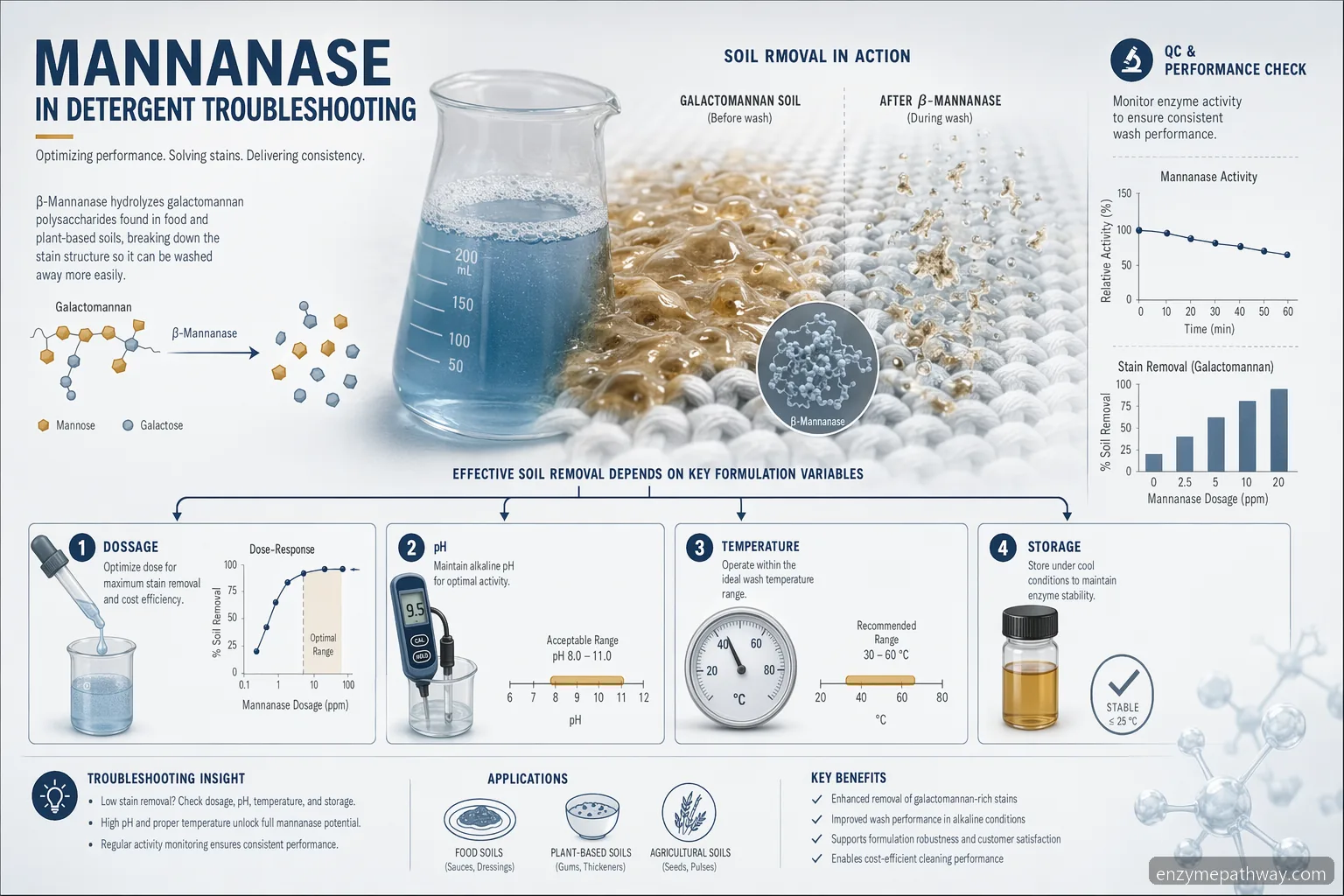
Why Mannanase Is Used in Laundry Detergent
Mannanase is an industrial enzyme used in detergent to hydrolyze beta-mannan gums, including guar gum and related galactomannans found in processed foods, sauces, ice cream stabilizers, cosmetics, and personal care residues. These soils can bind to cotton and synthetic fibers, trap particulate dirt, and leave a dull film after washing. A suitable mannanase enzyme in detergent breaks the beta-1,4-mannan backbone into smaller, more soluble fragments so surfactants and mechanical action can remove them more effectively. For B2B detergent buyers, the goal is not simply enzyme inclusion; it is consistent stain release at realistic wash conditions, acceptable shelf life, and competitive cost-in-use. Performance depends on the specific beta-mannanase strain, activity assay, formulation matrix, and consumer wash profile. Before approving a mannanase supplier for detergent, compare enzyme activity, recommended pH, temperature window, liquid stability, odor, color contribution, and handling requirements.
Targets guar gum and galactomannan-based food soils • Supports stain release in low- and medium-temperature washing • Must be validated in the complete detergent formula
Dosage: How to Start and Optimize
A practical starting point for mannanase in laundry detergent is often 0.05–0.30% of a commercial liquid enzyme preparation, or an equivalent activity dose supplied by the manufacturer. Granulated detergent enzymes may be evaluated at different inclusion rates, commonly established by activity units per kilogram of finished powder. Do not transfer dosage directly from another product without checking enzyme activity, formulation density, wash dose, dilution factor, and target stain type. In screening, run a dose-response curve with at least three enzyme levels, a blank without mannanase, and a benchmark enzyme if available. The best dosage is the lowest level that meets stain removal and fabric appearance targets after manufacturing and storage. For purchasing, request activity units, assay method, batch COA, and recommended dosing guidance in the TDS. Cost-in-use should be calculated per wash or per metric ton of finished detergent, not only by enzyme price per kilogram.
Screen low, mid, and high enzyme dosage levels • Normalize comparisons by declared activity units • Confirm performance after accelerated and real-time storage • Model cost-in-use before commercial approval
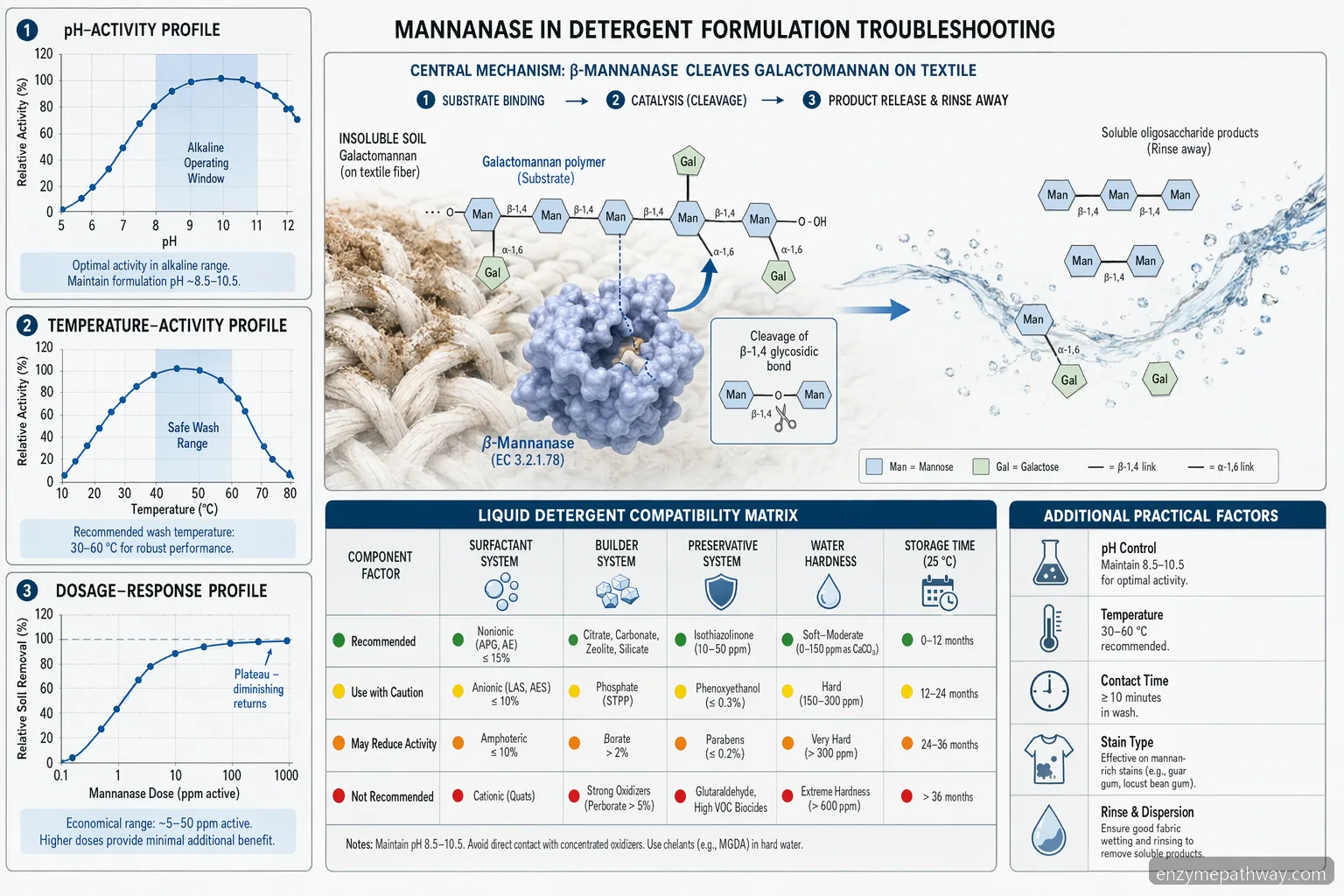
pH and Temperature Troubleshooting
The effective pH range for detergent mannanase is commonly evaluated around pH 7.0–10.5, with many laundry systems operating in the mildly alkaline to alkaline zone. Temperature screening should reflect the target market: cold wash around 20–30°C, warm wash around 40°C, and higher stress testing up to about 60°C where relevant. Loss of performance may come from enzyme denaturation, incompatible pH, short contact time, or poor dispersion into the wash liquor. If stain results are weak at high alkalinity, compare a more alkaline-tolerant beta-mannanase or adjust the builder system if formulation constraints allow. If performance drops in cold water, verify dissolution, enzyme activity at low temperature, and whether soils are hydrated before washing. Always separate wash performance testing from storage stability testing: an enzyme can work well in the wash but degrade during months in a liquid detergent concentrate.
Typical screening pH: 7.0–10.5 • Typical wash screening temperature: 20–60°C • Check both immediate activity and aged-product performance
Liquid Detergent Compatibility Checks
Using mannanase enzyme in detergent liquids requires more than a stain test on fresh product. The enzyme must remain active in a concentrated matrix containing anionic and nonionic surfactants, builders, solvents, preservatives, fragrance components, dyes, chelants, and sometimes other enzymes. Protease can damage enzymes if stabilization is inadequate, while high solvent or oxidizing systems may reduce activity. For liquid formulations, run compatibility tests at the intended storage pH and temperature, plus accelerated conditions such as 35–45°C for several weeks, depending on internal protocols. Measure residual mannanase activity, appearance, viscosity, phase stability, odor, and microbial control. If activity loss is high, discuss stabilizers, enzyme grade selection, encapsulation options, or separate addition strategy with the supplier. Confirm that the TDS gives recommended storage conditions and that the SDS covers safe handling of enzyme concentrates, which may be respiratory sensitizers.
Test with the full surfactant and builder package • Monitor residual activity after aging • Check viscosity, odor, color, and phase stability • Review SDS handling guidance before plant trials
QC, Pilot Validation, and Scale-Up
Before commercializing mannanase use in detergent, define a QC plan that links incoming enzyme quality to finished detergent performance. Incoming checks should include COA review, activity confirmation when feasible, appearance, lot number traceability, and storage condition verification. Finished-product checks may include pH, viscosity, density, enzyme residual activity, microbial limits if applicable, and stain panel testing after aging. Pilot validation should mimic manufacturing shear, addition temperature, hold time, and order of addition because enzymes can lose activity if added too early or exposed to unsuitable processing conditions. For powders, assess dust control, granule integrity, segregation, and post-blend activity. For liquids, confirm that the enzyme disperses uniformly and does not trigger haze or instability. Scale-up success depends on matching lab performance with factory handling, packaging, warehousing, and transport conditions, especially in hot climates.
Verify COA against purchase specifications • Add enzyme under supplier-recommended process conditions • Use aged stain panels for commercial approval • Maintain lot traceability from enzyme to finished product
Selecting a Mannanase Supplier for Detergent
A qualified mannanase supplier for detergent should provide more than a quotation. Request a current TDS with activity definition, recommended dosage, pH and temperature guidance, storage conditions, shelf-life statement, and formulation notes. The COA should show batch-specific activity and quality parameters, while the SDS should support worker safety review, labeling decisions, and warehouse procedures. Ask for application data based on detergent-relevant stain panels, not only general enzyme activity. For procurement, compare delivered cost, activity concentration, minimum order quantity, lead time, packaging, technical support, and batch consistency. For R&D, prioritize suppliers that can support pilot trials, troubleshoot compatibility, and supply samples from representative production batches. Avoid choosing solely on price per kilogram; a more concentrated or stable mannanase enzyme may reduce dosage, rework, complaints, and total cost-in-use.
Request COA, TDS, SDS, and sample availability • Compare activity-adjusted pricing • Review lead time, packaging, and storage needs • Confirm technical support for pilot validation
Technical Buying Checklist
Buyer Questions
Mannanase in detergent is used to break down beta-mannan gums such as guar and locust bean gum that appear in many processed food and personal care soils. These gums can bind dirt to fabric and form dull residues. In a properly designed detergent formula, beta-mannanase helps convert those gums into smaller fragments that are easier for surfactants and wash action to remove.
A common lab starting range is about 0.05–0.30% of a commercial liquid mannanase preparation, but the correct dose depends on activity units, detergent dose, wash liquor volume, target stains, and storage stability. Formulators should run a dose-response curve, include a no-enzyme control, and use the supplier TDS and COA to normalize results by activity rather than weight alone.
Many detergent mannanase candidates are screened around pH 7.0–10.5 because laundry products often operate in neutral to alkaline wash conditions. The actual workable range depends on the enzyme grade and formulation matrix. If performance is weak at high alkalinity, review the supplier’s TDS, test residual activity after storage, and compare more alkaline-tolerant enzyme options before changing the formula.
Mannanase can often be formulated with other detergent enzymes, but compatibility must be proven. Protease may reduce the stability of other enzymes if the liquid system is not properly stabilized. Test the complete formula with all enzymes present, then measure residual activity, stain removal, odor, viscosity, and phase stability after accelerated and real-time storage before approving a commercial blend.
Qualify a supplier by reviewing COA, TDS, SDS, activity method, shelf-life statement, storage guidance, batch consistency, and detergent application data. Request samples from representative production batches and run pilot validation under your manufacturing conditions. Procurement should compare activity-adjusted price, lead time, packaging, minimum order quantity, technical support, and total cost-in-use per wash or per metric ton of detergent.
Related Search Themes
mannanase, mannanase in laundry detergent, mannanase enzyme in detergent, mannanase enzyme, use of mannanase enzyme in detergent, new liquid tide w mannanase fluorescent diagram in laundry detergent
Mannanase for Research & Industry
Need Mannanase for your lab or production process?
ISO 9001 certified · Food-grade & research-grade · Ships to 80+ countries
Frequently Asked Questions
What is mannanase in detergent used for?
Mannanase in detergent is used to break down beta-mannan gums such as guar and locust bean gum that appear in many processed food and personal care soils. These gums can bind dirt to fabric and form dull residues. In a properly designed detergent formula, beta-mannanase helps convert those gums into smaller fragments that are easier for surfactants and wash action to remove.
What dosage of mannanase should a detergent formulator test first?
A common lab starting range is about 0.05–0.30% of a commercial liquid mannanase preparation, but the correct dose depends on activity units, detergent dose, wash liquor volume, target stains, and storage stability. Formulators should run a dose-response curve, include a no-enzyme control, and use the supplier TDS and COA to normalize results by activity rather than weight alone.
What pH is suitable for mannanase enzyme in detergent?
Many detergent mannanase candidates are screened around pH 7.0–10.5 because laundry products often operate in neutral to alkaline wash conditions. The actual workable range depends on the enzyme grade and formulation matrix. If performance is weak at high alkalinity, review the supplier’s TDS, test residual activity after storage, and compare more alkaline-tolerant enzyme options before changing the formula.
Can mannanase be used with protease and amylase?
Mannanase can often be formulated with other detergent enzymes, but compatibility must be proven. Protease may reduce the stability of other enzymes if the liquid system is not properly stabilized. Test the complete formula with all enzymes present, then measure residual activity, stain removal, odor, viscosity, and phase stability after accelerated and real-time storage before approving a commercial blend.
How should we qualify a mannanase supplier for detergent?
Qualify a supplier by reviewing COA, TDS, SDS, activity method, shelf-life statement, storage guidance, batch consistency, and detergent application data. Request samples from representative production batches and run pilot validation under your manufacturing conditions. Procurement should compare activity-adjusted price, lead time, packaging, minimum order quantity, technical support, and total cost-in-use per wash or per metric ton of detergent.
Related: Mannanase for Mannan-Rich Process Streams
Turn This Guide Into a Supplier Brief Request a detergent-grade mannanase sample, COA/TDS/SDS package, and pilot validation support for your formulation. See our application page for Mannanase for Mannan-Rich Process Streams at /applications/mannanase-industrial-processing/ for specs, MOQ, and a free 50 g sample.
Contact Us to Contribute